Hi everyone, our October book club gathering will be next Friday, October 9 at 3:00 p.m.
In recognition of Banned Books Week, October 4–10, our October Read is Ray Bradbury’s classic novel Fahrenheit 451.
The book is set in a future America at a time when books have been outlawed and “firemen” are assigned to burn any books found, not to put out fires.
The main character is Guy Montag who takes quite a journey in the novel, going from a firefighter working to destroy books and all the knowledge, ideas and culture they contain, to a book preservationist who does just the opposite – works to find and safeguard books, preserving them so they may be read in the future.
Looking forward to November, our November Book Club gathering will be held at the library on Friday, November 13 at 3:00 p.m. and we’ll be reading the novel The Frozen River by Ariel Lawhon.
The Frozen River is a historical mystery novel based on the life of Martha Ballard (1735 – 1812) who was born and raised in Massachusetts and moved with her husband to the wilds of the Kennebec Valley in what is today Maine in 1777. Ballard and her husband raised their family there and Ballard worked as a midwife in the region for decades, becoming a well-respected member of the local community. She started keeping a diary in 1785; and in her diary she listed the names and maladies of patients, herbs she used in treating patients and other tidbits of daily life – the diary eventually had more than 1,000 entries.
The novel is set in 1789 and opens with Ballard being called to examine a body found in the frozen Kennebec River. The body is determined to be that of Joshua Burgess one of two men recently accused of sexual assault by Rebecca Foster, the wife of the local minister.
Ballard records what she observes in her diary and works to solve the murder and obtain justice for Foster. She encounters many challenges along the way but does discover who murdered Ballard and obtains a bit of justice for Foster.
Copies of both Fahrenheit 451 and Frozen River may be picked up at the Circulation Desk at the library at any time.
And a Zoom option is available for book club gatherings. The Zoom link may be obtained by sending an email request to me at reimerl@stls.org
Never Caught: The Washingtons’ Relentless Pursuit Of Their Runaway Slave Ona Judge by Erica Armstrong Dubar. The title really gives you the basics of this non-fiction book – it tells the tale of Ona Judge (1774-1848) who was born enslaved at Mount Vernon in 1774. As a youth, she traveled with George & Martha Washington to Philadelphia, the first capital of the United States, and worked in the president’s household during the eight years of his two terms in office. Living in Philadelphia for those eight years, Judge would have seen the growing population of free persons of color who lived there and would have known about Pennsylvania’s Act for the Gradual Abolition of Slavery; the law, which was passed in 1780, decreed that any slaves born in the state before 1780 would remain slaves for life; but any slaves born in the state after 1780 would be freed once they reached the age of 28.
Then in 1796, it became known that President Washington was retiring, that his household would be returning to Viriginia and that Martha Washington planned to give Ona Judge to her hot-tempered granddaughter who was about to be married and who lived in Virginia where there was nothing like Pennsylvania’s Act for the Gradual Abolition of Slavery; Judge made the decision to escape and escape she did! To say the Washington’s were not pleased by her departure would be an understatement as they spent years trying to re-enslave her and to learn more, check out the book! Copies are available at the Circulation Desk.
About July’s Book Club:
In July we read and discussed the novel The Antidote by Karen Russell. The novel, which is a mixture of historical fiction and magical realism, is set in Uz, Nebraska during the Great Depression and tells that tale of an ensemble cast of characters including: Toni Rossi a prairie witch who, has been for many years a living vault for memories people don’t wish to lose but don’t want to live with but who is now having issues retrieving those stored memories; Dell an orphaned teenager who is a talented basketball player and wants to make some money by working with Toni and learning to become a prairie witch; Harp Oletsky, Dell’s uncle and a local farmer whose fields, unlike the fields of his neighbors are lush and growing and seemingly unaffected by the dust bowl and the Scarecrow, who is literally a scarecrow standing in Harp Oletsky’s field; and more, because as the novel unfolds readers become aware the Scarecrow holds the spirit of Toni’s son who she was forced to give up when she was young; and who recently died in a automobile accident.
The Graflex Speed Camera mentioned in the novel looks like this:
And as a coda to the July book club read; here is a link to a short documentary about the Farm Security Administration during the Great Depression, which was indeed headed by Roy Stryker, who made appearances in the novel as the fictional photographer, Cleo Allfrey’s boss. The short documentary is produced by the official FDR Presidential Library:
Books Read in the Past Month by Book Club Members
Titles are books unless otherwise noted —
California Sorcery: A Group Celebration edited by William F. Nolan
Here’s a book of magic, all right — all right, dark magic — and its contributors are, as the title implies, sorcerers of their craft. California Sorcery provides a virtual roll call of some of the most important names in the history of 20th-century horror, sci fi, and dark fantasy: Robert Bloch, Ray Bradbury, Richard Matheson, Charles Beaumont — just to name a few. And this is no reprint sham like we’ve seen too many times before; nine of the 12 stories were never-before-published! (The Bloch piece hasn’t seen print in 50 years, and Harlan Ellison’s piece is newly revised.)
We’re talking the greats of the field, folks, guys who were writing high-octane tales of terror when Stephen King was still playing with toy soldiers. (King, in fact, has acknowledged a number of these authors as major influences.) In their day (though many are still actively writing) the contributors here were known in Hollywood as “The California School” or simply, “The Group”; they became a notorious creative coterie due to their sheer, indefatigable talent and, combined, helped brand the entertainment industry with some of the finest scripts, novels, and stories ever produced. Coeditor William Nolan says it best in his foreword: “The Group lives again in this book, brought together at last and for always…”
–
The Foursome: A Novel: by Christina Baker Kline
When Eng and Chang Bunker arrive in Wilkes County in 1839, they’re not just a curiosity—they’re a sensation. Everyone is eager to learn whether the salacious rumors about them are true. Within months, the twins have opened a general store, bought land, and begun building a plantation. Now, word has it, they’re looking for wives—and in a place that thrives on gossip and legacy, their ambitions set the community on edge.
Sarah and Adelaide Yates, daughters of a once-prominent local family brought low by scandal, are drawn into their orbit. Bold, beautiful Adelaide sees in the twins’ fame a chance to reclaim her future. Sarah, quiet and observant, isn’t so sure. When the twins’ lives become entangled with theirs, they must navigate loyalty, longing, and identity in a world where everything—including race, class, and gender—is rigidly defined.
Spanning five decades and unfolding against the backdrop of a fractured nation hurtling toward war, The Foursome is both intimate and epic: a story of love and constraint, identity and reinvention. With piercing insight and emotional precision, Kline brings to life a forgotten chapter of American history and the complex, boundary-defying marriages at its center.
–
Inside the O’Briens: A Novel by Lisa Genova
Joe O’Brien is a forty-three-year-old police officer from the Irish Catholic neighborhood of Charlestown, Massachusetts. A devoted husband, proud father of four children in their twenties, and respected officer, Joe begins experiencing bouts of disorganized thinking, uncharacteristic temper outbursts, and strange, involuntary movements. He initially attributes these episodes to the stress of his job, but as these symptoms worsen, he agrees to see a neurologist and is handed a diagnosis that will change his and his family’s lives forever: Huntington’s disease.
Huntington’s is a lethal neurodegenerative disease with no treatment and no cure, and each of Joe’s four children has a fifty percent chance of inheriting their father’s disease. While watching her potential future in her father’s escalating symptoms, twenty-one-year-old daughter Katie struggles with the questions this test imposes on her young adult life. As Joe’s symptoms worsen and he’s eventually stripped of his badge and more, Joe struggles to maintain hope and a sense of purpose, while Katie and her siblings must find the courage to either live a life “at risk” or learn their fate.
Praised for writing that “explores the resilience of the human spirit” (San Francisco Chronicle), Lisa Genova has once again delivered a novel as powerful and unforgettable as the human insights at its core.
–
John Adams by David McCullough
The Pulitzer Prize–winning, bestselling biography of America’s founding father and second president that was the basis for the acclaimed HBO series, brilliantly told by master historian David McCullough.
In this powerful, epic biography, David McCullough unfolds the adventurous life journey of John Adams, the brilliant, fiercely independent, often irascible, always honest Yankee patriot who spared nothing in his zeal for the American Revolution; who rose to become the second president of the United States and saved the country from blundering into an unnecessary war; who was learned beyond all but a few and regarded by some as “out of his senses”; and whose marriage to the wise and valiant Abigail Adams is one of the moving love stories in American history.
This is history on a grand scale—a book about politics and war and social issues, but also about human nature, love, religious faith, virtue, ambition, friendship, and betrayal, and the far-reaching consequences of noble ideas. Above all, John Adams is an enthralling, often surprising story of one of the most important and fascinating Americans who ever lived.
–
The Most Fun We Ever Had: A Novel by Claire Lombardo
In this “rich, complex family saga” (USA Today) full of long-buried family secrets, Marilyn Connolly and David Sorenson fall in love in the 1970s, blithely ignorant of all that awaits them. By 2016, they have four radically different daughters, each in a state of unrest.
Wendy, widowed young, soothes herself with booze and younger men; Violet, a litigator turned stay-at-home-mom, battles anxiety and self-doubt; Liza, a neurotic and newly tenured professor, finds herself pregnant with a baby she’s not sure she wants by a man she’s not sure she loves; and Grace, the dawdling youngest daughter, begins living a lie that no one in her family even suspects.
With the unexpected arrival of young Jonah Bendt—a child placed for adoption by one of the daughters fifteen years before—the Sorensons will be forced to reckon with the rich and varied tapestry of their past. As they grapple with years marred by adolescent angst, infidelity, and resentment, they also find the transcendent moments of joy that make everything else worthwhile.
–
On Witness and Respair: Essays by Jesmyn Ward
The collected creative nonfiction of a singular American writer, Jesmyn Ward, including widely shared classics, three never-before-published speeches, and an introductory essay.
Respair (noun, obsolete), fresh hope after despair.
From the two-time National Book Award winner and New York Times bestselling author Jesmyn Ward, this collection of essays documents more than a decade of work in the life of a singular writer often lauded as “the heir apparent to Toni Morrison” (LitHub). Beginning with her upbringing in a multigenerational household in rural Mississippi, the cradle of both her youth and her gift for storytelling, Ward brings her keen wisdom and hauntingly lyrical prose to a range of topics, following in her grandmother Dorothy’s footsteps when she promises always to “Tell it straight. Tell it all.”
True to her word, in these pages Ward contemplates the writers and novels of her youth and adulthood—the transformative power of discovering Octavia Butler as a twenty-something, the mirror that Richard Wright’s novels held up to her own childhood, and of course, her lifelong love for Toni Morrison. Ward ruminates on her approach to both fiction and life, reflecting on the power of the novel, how to raise a Black son in an era of rising divisiveness and cruelty, as well as her own personal tragedies—including the titular essay of the collection, which tells the story of her partner’s sudden death on the eve of the COVID-19 epidemic. Every bit as piercing and moving as her fiction, On Witness and Respair is a testament to Ward’s powers as “one of America’s finest living writers” (San Francisco Chronicle) and is a monument to hope, beauty, and personal and collective resilience.
–
Platonic: How the Science of Attachment Can Help You Make–and Keep—Friends by Marisa G. Franco PhD
How do we make and keep friends in an era of distraction, burnout, and chaos, especially in a society that often prizes romantic love at the expense of other relationships? In Platonic, Dr. Marisa G. Franco unpacks the latest, often counterintuitive findings about the bonds between us—for example, why your friends aren’t texting you back (it’s not because they hate you!), and the myth of “friendships happening organically” (making friends, like cultivating any relationship, requires effort!). As Dr. Franco explains, to make and keep friends you must understand your attachment style—secure, anxious, or avoidant: it is the key to unlocking what’s working (and what’s failing) in your friendships.
Making new friends, and deepening longstanding relationships, is possible at any age—in fact, it’s essential. The good news: there are specific, research-based ways to improve the number and quality of your connections using the insights of attachment theory and the latest scientific research on friendship. Platonic provides a clear and actionable blueprint for forging strong, lasting connections with others—and for becoming our happiest, most fulfilled selves in the process.
–
The Tale Teller by Anne Hillerman
Joe Leaphorn may have retired from the Tribal Police, but he finds himself knee-deep in a perplexing case involving a priceless artifact—a reminder of a dark time in Navajo history. Joe’s been hired to find a missing biil, a traditional dress that had been donated to the Navajo Nation. His investigation takes a sinister turn when the leading suspect dies under mysterious circumstances and Leaphorn himself receives anonymous warnings to beware—witchcraft is afoot.
While the veteran detective is busy working to untangle his strange case, his former colleague Jim Chee and Officer Bernie Manuelito are collecting evidence they hope will lead to a cunning criminal behind a rash of burglaries. Their case takes a complicated turn when Bernie finds a body near a popular running trail. The situation grows more complicated when the death is ruled a homicide, and the Tribal cops are thrust into a turf battle because the murder involves the FBI.
As Leaphorn, Chee, and Bernie draw closer to solving these crimes, their parallel investigations begin to merge . . . and offer an unexpected opportunity that opens a new chapter in Bernie’s life.
–
Theo of Golden: A Novel by Allen Levi
One spring morning, a stranger named Theo arrives in the small Southern city of Golden. He doesn’t explain much about where he came from or why he’s there—but when he visits the local coffeehouse, where pencil portraits of the people of Golden hang on the walls, he begins purchasing them, one at a time, and giving each portrait to the person depicted. In exchange, he asks only for the person’s story. And so portrait by portrait, person by person, secrets are revealed, regrets are shared, and ordinary lives are profoundly altered.
A story of giving and receiving, of seeing and being seen, Theo of Golden is an unforgettable novel about the power of generosity, the importance of connection, and the quiet miracles that happen when we choose kindness and wonder.
–
The Wager: A Tale of Shipwreck, Mutiny and Murder by David Grann
On January 28, 1742, a ramshackle vessel of patched-together wood and cloth washed up on the coast of Brazil. Inside were thirty emaciated men, barely alive, and they had an extraordinary tale to tell. They were survivors of His Majesty’s Ship the Wager, a British vessel that had left England in 1740 on a secret mission during an imperial war with Spain. While the Wager had been chasing a Spanish treasure-filled galleon known as “the prize of all the oceans,” it had wrecked on a desolate island off the coast of Patagonia. The men, after being marooned for months and facing starvation, built the flimsy craft and sailed for more than a hundred days, traversing nearly 3,000 miles of storm-wracked seas. They were greeted as heroes.
But then … six months later, another, even more decrepit craft landed on the coast of Chile. This boat contained just three castaways, and they told a very different story. The thirty sailors who landed in Brazil were not heroes – they were mutineers. The first group responded with countercharges of their own, of a tyrannical and murderous senior officer and his henchmen. It became clear that while stranded on the island the crew had fallen into anarchy, with warring factions fighting for dominion over the barren wilderness. As accusations of treachery and murder flew, the Admiralty convened a court martial to determine who was telling the truth. The stakes were life-and-death—for whomever the court found guilty could hang.
The Wager is a grand tale of human behavior at the extremes told by one of our greatest nonfiction writers. Grann’s recreation of the hidden world on a British warship rivals the work of Patrick O’Brian, his portrayal of the castaways’ desperate straits stands up to the classics of survival writing such as The Endurance, and his account of the court martial has the savvy of a Scott Turow thriller. As always with Grann’s work, the incredible twists of the narrative hold the reader spellbound.
–
Young George Washington (2026) (Movie)
Before he became the first President of the United States, young George Washington tests his honor, loyalty and courage by fighting in the French and Indian War. As alliances crumble and the frontier erupts into battle, he must confront not only his enemies, but the man he’s becoming.
–
Whistler: A Novel by Ann Patchett
When Daphne Fuller and her husband Jonathan visit the Metropolitan Museum of Art, they notice an older, white-haired gentleman following them. The man turns out to be Eddie Triplett, her former stepfather, who had been married to her mother for a little more than year when Daphne was nine. Now fifty-three, Daphne hasn’t seen Eddie for many years, not since the fateful event that changed the direction of both their lives. Meeting again, time falls away; while their relationship was brief, it had a profound impact on them both, and now that they are reunited, they have no intention of ever being separated again.
Whistler is a story about two adults looking back over the choices they made, and the choices that were made for them. It’s a story about bravery, memory, the often small yet consequential moments that define our lives, and the endless stream of loss that in time comes for us all. Beautiful in its simplicity, it is ultimately about how love endures, and how the feeling of being known by one other person, even for a short period of time, can change everything.
To see a list of upcoming library events, visit the library’s calendar of events page via the following link: https://ssclibrary.org/calendar/
Alternatively, you can search for eBooks and eAudios via the Libby or Hoopla apps – all you need is a library card; if you have questions please call the library at: 607-936-3713
We’ll be discussing the novel The Antidote by Karen Russell; copies of which are available at the Circulation Desk if anyone needs a copy.
Here is the Starred Booklist review of the title:
The Antidote by Karen Russell: The prairie witch calls herself The Antidote because people feel so much better after she unburdens them of painful memories, storing them in her “vault.” But when she finds herself in jail in the midst of a terrifying dust storm in Uz, Nebraska, she realizes that the deposits she’s been paid to protect have vanished. High-school basketball star Asphodel Oletsky, living, since her mother was murdered, with her uncle Harp, a dryland farmer, is desperate to keep her winning team on the court after they lose their sponsor. Harp is haunted by how his Polish parents were forced off their land by the Germans, only to find themselves unwittingly doing the same to Native Americans. New Deal photographer Cleo Allfrey, at risk on the plains as a Black woman, arrives in Uz during the worst of the Dust Bowl and finds people pushed to the brink by drought, deadly and otherworldly dust storms, vanished crops and topsoil, unsolved murders, and a corrupt and brutal sheriff. Among many strange occurrences, Cleo’s photographs inexplicably depict the horrific past and a possible future. Highly honored Russell follows two stellar story collections with her second novel, an ardent work of encompassing and compassionate historical fiction supercharged with her signature imaginative, astutely calibrated supernatural twists. A dramatic and uncanny tale of the drastic consequences of our destruction of nature and Indigenous communities.
Looking forward to August, we’ll be meeting on Friday, August 14 from 3:00 – 4:00 p.m. and we’ll be discussing the novel The Correspondent by Virginia Evans.
Here is the Publishers Weekly Review of the novel:
The Correspondent by Virginia Evans: The charming debut from Evans takes the form of letters and emails exchanged by a divorced and retired woman with her friends, family, foes, and literary idols. It begins in 2012 as Sybil Van Antwerp, 73, politely declines an invitation to visit her brother, Felix, in France, then fancifully invites the author Ann Patchett to use her Maryland home as a writer’s retreat. Sybil spent her career clerking for a judge, and after reading of his death in the newspaper, she begins receiving strange and threatening letters from an aggrieved former defendant, who calls her a “cold metal bitch.” Evans juxtaposes these screeds with Sybil’s intimate fan mail to Joan Didion, who writes her back in 2013, expressing empathy as a fellow member of “the club of parents who have buried children” (Sybil lost a son at eight). Sybil, who was adopted, grows curious about her ancestry after her older son gives her a DNA test for Christmas, and she brushes off concerns about her declining eyesight from her daughter, Fiona, who lives in Australia. As the years go on, Sybil’s relationships brim with tension waiting to be released, and the detailed connections between each character are brilliantly mapped through the correspondence. It adds up to an appealing family drama.
–
And just as FYI, the Summer Reading seasons has started & you can sign up for the Summer Reading program at the Reference Desk. You can win prizes for reading and improve library stats too!
There are also special events for all ages during the Summer Reading Program season and here is the Summer Reading Programming brochure with all the events, dates & times:
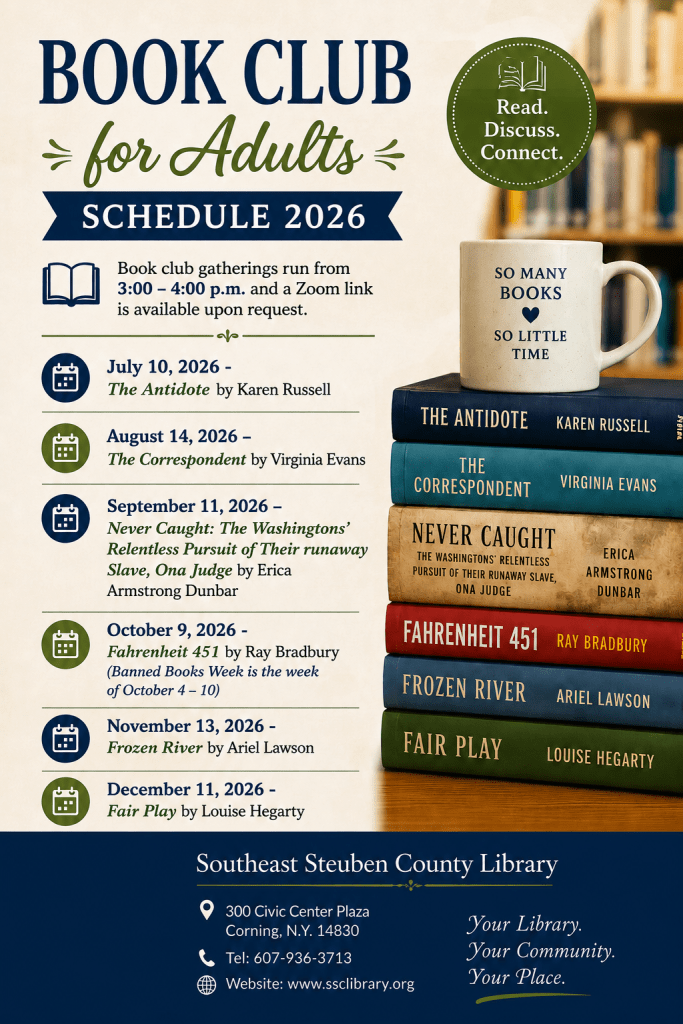
And here is the updated Book Club Schedule for the balance of 2026:
–
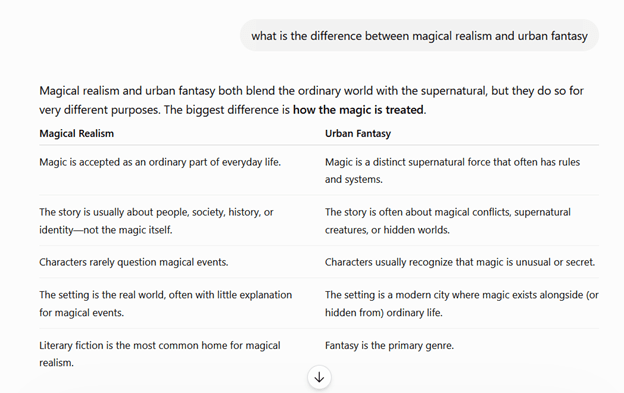
What’s the difference between: “Magical Realism” and “Urban Fantasy?” This topic came up during our June gathering, and I thought I’d check so I’d have a more concrete answer to the question!
So here is more information on the subject:
Magical Realism
In magical realism, the extraordinary is woven seamlessly into everyday life. The magical elements are rarely explained because the story is not about the magic—it is about the human experience.
Examples
One Hundred Years of Solitude — Gabriel García Márquez
Love in the Time of Cholera — Gabriel García Márquez (contains magical realist elements)
The House of the Spirits — Isabel Allende
Like Water for Chocolate — Laura Esquivel
Beloved — Toni Morrison
The Famished Road — Ben Okri
Exit West — Mohsin Hamid
The Particular Sadness of Lemon Cake — Aimee Bender
Urban Fantasy
Urban fantasy takes place in a recognizable modern world where magic, supernatural beings, or mythical creatures exist alongside ordinary life—often hidden from most people.
Examples
Storm Front — Jim Butcher
Moon Called — Patricia Briggs
Magic Bites — Ilona Andrews
Rivers of London — Ben Aaronovitch
Neverwhere — Neil Gaiman
American Gods — Neil Gaiman
Dead Until Dark — Charlaine Harris
Rosemary and Rue — Seanan McGuire
–
Books Read by Book Club Members in June (and reported at the June gathering):
God Impulse: The Power of Mercy In An Unmerciful World by Jack Alexander: For Jesus, truth and mercy went hand in hand. Where he preached he also healed. He didn’t outsource one or the other to biblical scholars or nonprofit ministries. He presented the truth of the gospel through his words and his actions, and he did it all in a hands-on, relational way. And the reaction was the same wherever he went–people were amazed.
Today we seem to have lost this powerful pattern of self-giving love, focusing on truth at the expense of mercy or on mercy at the expense of truth, and often failing to build genuine, lasting relationships with the people around us.
In The God Impulse, Jack Alexander helps us recover Jesus’s model, showing through biblical and modern real-life stories that God’s first impulse toward us is mercy. He then sets forth a pattern for us to follow–to see, go, do, and endure–that not only spreads truth and love to those around us who are suffering but also causes them to gasp in amazement and consider the claims of the gospel for themselves.
–
God: A Biography: Pulitzer Prize Winner by Jack Miles: WINNER OF THE PULITZER PRIZE
What sort of “person” is God? What is his “life story”? Is it possible to approach him not as an object of religious reverence, but as the protagonist of the world’s greatest book—as a character who possesses all the depths, contradictions, and ambiguities of a Hamlet? This is the task that Jack Miles—a former Jesuit trained in religious studies and Near Eastern languages—accomplishes with such brilliance and originality in God: A Biography.
Using the Hebrew Bible as his text, Miles shows us a God who evolves through his relationship with man, the image who in time becomes his rival. Here is the Creator who nearly destroys his chief creation; the bloodthirsty warrior and the protector of the downtrodden; the lawless law-giver; the scourge and the penitent. Profoundly learned, stylishly written, the resulting work illuminates God and man alike and returns us to the Bible with a sense of discovery and wonder.
–
Isola by Allegra Goodman: Heir to a fortune, Marguerite is destined for a life of prosperity and gentility. Then she is orphaned, and her guardian—an enigmatic and volatile man—spends her inheritance and insists she accompany him on an expedition to New France. That journey takes a unexpected turn when Marguerite, accused of betrayal, is brutally punished and abandoned on a small island.
Once a child of privilege who dressed in gowns and laced pearls in her hair, Marguerite finds herself at the mercy of nature. As the weather turns, blanketing the island in ice, she discovers a faith she’d never before needed.
Inspired by the real life of a sixteenth-century heroine, Isola is the timeless story of a woman fighting for survival.
–
On Witness and Respair: Essays by Jesmyn Ward: From the two-time National Book Award winner and New York Times bestselling author Jesmyn Ward, this collection of essays documents more than a decade of work in the life of a singular writer often lauded as “the heir apparent to Toni Morrison” (LitHub).
Beginning with her upbringing in a multigenerational household in rural Mississippi, the cradle of both her youth and her gift for storytelling, Ward brings her keen wisdom and hauntingly lyrical prose to a range of topics, following in her grandmother Dorothy’s footsteps when she promises always to “Tell it straight. Tell it all.”
True to her word, in these pages Ward contemplates the writers and novels of her youth and adulthood—the transformative power of discovering Octavia Butler as a twenty-something, the mirror that Richard Wright’s novels held up to her own childhood, and of course, her lifelong love for Toni Morrison. Ward ruminates on her approach to both fiction and life, reflecting on the power of the novel, how to raise a Black son in an era of rising divisiveness and cruelty, as well as her own personal tragedies—including the titular essay of the collection, which tells the story of her partner’s sudden death on the eve of the COVID-19 epidemic. Every bit as piercing and moving as her fiction, On Witness and Respair is a testament to Ward’s powers as “one of America’s finest living writers” (San Francisco Chronicle) and is a monument to hope, beauty, and personal and collective resilience.
–
The Retirement Plan: A Novel by Sue Hincenbergs:
THEY’D KILL TO BE WIDOWS.
Three best friends turn to murder to collect on their husbands’ life insurance policies… But the husbands have a plan of their own in this darkly funny debut suspense novel that will delight readers from the first laugh to the final twist.
After thirty years of friendship, Pam dreams of her perfect retirement with Nancy, Shalisa, Marlene, and their husbands—until their husbands pool their funds for an investment that goes terribly wrong. Suddenly, in this witty domestic thriller, their golden years are looking as dreary as their marriages.
But when the women discover their husbands have seven-figure life insurance policies, a new dream forms. And this time, they need a hitman.
Meanwhile, their husbands are working on their own secret retirement scheme and when things begin to go sideways, they fear it’s backfired. The husbands scramble to stay alive…but soon realize they may not be quick enough to outmaneuver their wives.
–
Theo of Golden by Allen Levi: One spring morning, a stranger named Theo arrives in the small Southern city of Golden. He doesn’t explain much about where he came from or why he’s there—but when he visits the local coffeehouse, where pencil portraits of the people of Golden hang on the walls, he begins purchasing them, one at a time, and giving each portrait to the person depicted. In exchange, he asks only for the person’s story. And so portrait by portrait, person by person, secrets are revealed, regrets are shared, and ordinary lives are profoundly altered.
A story of giving and receiving, of seeing and being seen, Theo of Golden is an unforgettable novel about the power of generosity, the importance of connection, and the quiet miracles that happen when we choose kindness and wonder.
–
Two Women Living Together by Kim Hana & Hwang Sunwoo: The big-hearted, bestselling South Korean memoir co-written by two best friends flouting gender norms and societal expectations with their decision to grow old together under one roof.
When most of their peers were moving in with romantic partners and having children, Kim Hana and Hwang Sunwoo chose independence—savoring solitude, quiet mornings, and the unmitigated freedom of living alone. But in their forties, something shifted, and they were met with a new, unexpected loneliness. Refusing to settle for the outdated choice between marriage or isolation, Hana and Sunwoo made a radical decision: to buy a home and live together—not as lovers, not as roommates, but as chosen family.
Now a bustling household of two women and four cats, Hana and Sunwoo still value solitude, but can do so while sharing a life and its meaning with someone else. Together they navigate the challenges and comforts of cohabiting in midlife, the growing pains of interdependence and the unexpected rewards of compromise when you’ve grown set in your ways. From sick days to career wins to aging parents and beach-side retirement plans, they are redefining domestic bliss on their own terms, where love, partnership, and home are defined not by tradition, but by choice.
With warmth, wit, and sharp social insight, Hana and Sunwoo share their blueprint for building a life outside the scripts of marriage and society’s expectations for women. Two Women Living Together is a quiet revolution—a celebration of female friendship, community, and the many forms that love and family can take.
–
The Universal Christ: How a Forgotten Reality Can Change Everything We See, Hope For, and Believe by Richard Rohr and Brian D. Mclaren: “Anyone who strives to put their faith into action will find encouragement and inspiration in the pages of this book.”—Melinda Gates
In his decades as a globally recognized teacher, Richard Rohr has helped millions realize what is at stake in matters of faith and spirituality. Yet Rohr has never written on the most perennially talked about topic in Christianity: Jesus. Most know who Jesus was, but who was Christ? Is the word simply Jesus’s last name? Too often, Rohr writes, our understandings have been limited by culture, religious debate, and the human tendency to put ourselves at the center.
Drawing on scripture, history, and spiritual practice, Rohr articulates a transformative view of Jesus Christ as a portrait of God’s constant, unfolding work in the world. “God loves things by becoming them,” he writes, and Jesus’s life was meant to declare that humanity has never been separate from God—except by its own negative choice. When we recover this fundamental truth, faith becomes less about proving Jesus was God, and more about learning to recognize the Creator’s presence all around us, and in everyone we meet.
Thought-provoking, practical, and full of deep hope and vision, The Universal Christ is a landmark book from one of our most beloved spiritual writers, and an invitation to contemplate how God liberates and loves all that is.
–
Wild Thing: A Life of Paul Gauguin by Sue Prideaux: An original and revealing portrait of the misunderstood French Post-Impressionist artist.
Paul Gauguin’s legend as a transgressive genius arises as much from his biography as his aesthetically daring Polynesian paintings. Gauguin is chiefly known for his pictures that eschewed convention, to celebrate the beauty of an indigenous people and their culture. In this gorgeously illustrated, myth-busting work, Sue Prideaux reveals that while Gauguin was a complicated man, his scandalous reputation is largely undeserved.
Self-taught, Gauguin became a towering artist in his brief life, not just in painting but in ceramics and graphics. He fled the bustle of Paris for the beauty of Tahiti, where he lived simply and worked consistently to expose the tragic results of French Colonialism. Gauguin fought for the rights of Indigenous people, exposing French injustices and corruption in the local newspaper and acting as advocate for the Tahitian people in the French colonial courts. His unconventional career and bold, breathtaking art influenced not only Vincent van Gogh, but Matisse and Picasso.
Wild Thing upends much of what we thought we knew about Gauguin through new primary research, including the resurfaced manuscript of Gauguin’s most important writing, the untranslated memoir of Gauguin’s son, and a sample of Gauguin’s teeth that disproves the pernicious myth of his syphilis. In the first full biography of Paul Gauguin in thirty years, Sue Prideaux illuminates the extraordinary oeuvre of a visionary artist vital to the French avant-garde. The result is “a brilliantly readable and compassionate study of Gauguin―not just as a painter, sculptor, carver and potter, but as a human soul perpetually searching for what is always just out of reach” (Artemis Cooper, Spectator).
–
Yesteryear by Caro Claire Burke: Natalie lives a traditional lifestyle. Her charming farmhouse is rustic, her husband a handsome cowboy, her six children each more delightful than the last. So what if there are nannies and producers behind the scenes, her kitchen hiding industrial-grade fridges and ovens, her husband the heir to a political dynasty? What Natalie’s followers—all 8 million of them—don’t know won’t hurt them. And The Angry Women? The privileged, Ivy League, coastal elite haters who call her an antifeminist iconoclast? They’re sick with jealousy. Because Natalie isn’t simply living the good life, she’s living the ideal—and just so happens to be building an empire from it.
Until one morning she wakes up in a life that isn’t hers. Her home, her husband, her children—they’re all familiar, but something’s off. Her kitchen is warmed by a sputtering fire rather than electricity, her children are dirty and strange, and her soft-handed husband is suddenly a competent farmer. Just yesterday Natalie was curating photos of homemade jam for her Instagram, and now she’s expected to haul firewood and handwash clothes until her fingers bleed. Has she become the unwitting star of a ruthless reality show? Could it really be time travel? Is she being tested by God? By Satan? When Natalie suffers a brutal injury in the woods, she realizes two things: This is not her beautiful life, and she must escape by any means possible.
A gripping, electrifying novel that is as darkly funny as it is frightening, Yesteryear is a gimlet-eyed look at tradition, fame, faith, and the grand performance of womanhood.
Hi everyone, just a quick reminder; the June Book Club for Adults gathering is this Friday, June 12, 2026, start time 3:00 p.m.
We’ll be discussing the book “My Name Is Emilia del Valle” by Isabel Allende. The novel is set in the mid-nineteenth century and tells the story of the character of the title, Emilia del Valle. Emilia is born in San Francisco in 1866 the out-of-wedlock daughter of an Irish nun and a Chilean aristocrat. She is raised by her supportive stepfather and grows into a strong willed, independent woman with a passion for writing. As an adult, she finds love and encounters her father while perusing her calling to write. The novel unfolds during the Chilean Civil War. Copies of the back are still available at the Circulation Desk.
Zoom link available upon request; you can request the link by sending an email to: reimerl@stls.org
Looking forward, our July read is “The Antidote” by Karen Russell. The Antidote is a critically acclaimed novel, which has a bit of everything. It unfolds in the small town of Uz, Nebraska during the Great Depression, during a dust storm, and follows an ensemble cast of characters including prairie witch Antonina Rossi who is something of a counselor for local residents, Harp Oletsky a man who stood with his parents as Pawnee people were driven from their land – the land his family was settling, Dell Oletsky a 15-year-old basketball prodigy whose mother Lada was just murdered, hobo Clemson Louis Dew who has falsely been convicted of Lada’s murder and Cleo Allfrey, a black New Deal photographer, who doesn’t believe Clemson Dew is guilty.
And looking backwards to our May; in May we read and discussed “Travels With George” by Nathaniel Philbrick. The book was inspired by John Steinbeck’s famous 1962 travelogue “Travels With Charley” which chronicled Steinbeck’s cross-country trip from Maine to California with his wife’s dog Charley. Steinbeck, who was in shaky health, wanted to see America, and what Americans were like; one last time before he passed. Taking a page out of Steinbeck’s book, Nathaiel Philbrick’s goal was to travel the roads George Washington traveled in 1780, to meet and greet Americans and see what their thought and concerns were about the state of the word; after he was elected President and before he settled down to govern. Two hundred and twenty-nine years after Washington made that trip, Philbrick, accompanied by his wife Melissa and their dog Dora, followed in his footsteps, traveling the same roads and reflecting on the history of the United States, with a strong emphasis on George Washington and the formative years of the country, and pondering the ways that, that history is important today and reflects who we are as a nation.
Hi everyone, the May book club for adults gathering is this Friday, May 8, 2026.
We’ll be meeting at the library at 3:00 p.m. and discussing the book Travels With George by Nathaniel Philbrick; copies of the book are available at the Circulation Desk if anyone needs a copy. If you’d like to attend the gathering from home, let me know and I’ll send you the Zoom link.
And looking forward to June, as usual we’ll be meeting the second Friday of the month – in June that is Friday, June 12, from 3:00 – 4:00 p.m.
And our June Reads is My Name Is Emilia del Valle: A Novel by Isabel Allende and Frances Riddle; and here the Booklist review of the novel:
Allende has created many addictive sagas about the extended del Valle family and their intersections with history and one another. The eponymous Emilia, Allende’s addition to this notable clan, is one adventurous, gutsy woman. The illegitimate daughter of a Chilean aristocrat and the Irish novice nun he seduced, Emilia grows up in San Francisco with her loving stepfather’s support, intrepidly working around gender restrictions. After penning dime novels pseudonymously, she becomes a human-interest columnist for the Daily Examiner and wangles an assignment as international correspondent for the impending Chilean Civil War of 1891, under her own byline. Emilia’s first meeting with her long-lost father in Santiago is quite moving, and her time with the canteen girls who accompany President Balmaceda’s army echoes with their unsung courage. Allende expertly navigates through the violent chaos of battle and how it affects Emilia, whose romantic relationships also showcase her character growth. Fans of Allende’s now-classic Daughter of Fortune (1999) and Portrait in Sepia (2000) will particularly welcome this offering, which is replete with Allende’s customary poetic storytelling.
HIGH-DEMAND BACKSTORY: Allende fans are legion and her continuation the del Valle family saga will inspire many requests.
Copies of our June read may also be picked up at the Circulation Desk at any time.
Hi everyone, just a reminder, our October book club gathering is this Friday, October 10, from 3:00 – 4:00 p.m. We’ll be meeting at the library and discussing the novel Tom Lake by Ann Patchett.
Looking forward to November, we’ll be meeting on Friday, November 14 from 3:00 – 4:00 p.m., and discussing the book When Books Went To War: The Stories That Helped Us Win World War II by Molly G. Manning; this book received positive reviews, including a glowing one from the retired head of Circulation for the library, Marcia Stewart.
Here is an overview of the book from the publisher:
While the Nazis were burning hundreds of millions of books across Europe, America printed and shipped 140 million books to its troops. The “heartwarming” story of how an army of librarians and publishers lifted spirits and built a new democratic audience of readers is as inspiring today as it was then (New York Times).
When America entered World War II in 1941, we faced an enemy that had banned and burned 100 million books. Outraged librarians launched a campaign to send free books to American troops and gathered 20 million hardcover donations.
In 1943, the War Department and the publishing industry stepped in with an extraordinary program: 120 million small, lightweight paperbacks for troops to carry in their pockets and rucksacks in every theater of war. These Armed Services Editions were beloved by the troops and are still fondly remembered today.
Soldiers read them while waiting to land at Normandy, in hellish trenches in the midst of battles in the Pacific, in field hospitals, and on long bombing flights. They helped rescue The Great Gatsby from obscurity and made Betty Smith, author of A Tree Grows in Brooklyn, into a national icon.
Copies of When Books Went To War can be picked up at the Circulation Desk starting today.
And looking further forward, our December 2025 gathering will take place on Friday, December 12 and we will be discussing the short novel Small Things Like These by Clarie Keegan. Copies of our December read will be available at the library the first week of December, and copies may be requested now by anyone who’d like to read ahead.
Hi everyone, the Southeast Steuben County Library Book Club for Adults gathering, for September 2025, will be held this Friday, September 12, from 3:00 – 4:00 p.m. at the library.
Our read for September is The Midnight Library by Matthew Haig. The book, which is in the same ball park, story-telling-format-wise as the movie It’s A Wonderful Life, tells the tale of Nora Seed, a woman in her thirties who regrets decisions she made in her teens and who is having a hard time. Her best friend has moved abroad; she isn’t getting along with her brother and has just lost her job. And to add to all of that her cat just died. So, a distraught Nora attempts suicide and winds up in limbo at a place called The Midnight Library where she will be able to see how making different decisions at different times in her life would have led to different outcomes.
Copies of the book are available at the Circulation Desk and may be picked up at any time.
Looking forward to October, we’ll be meeting on Friday, October 10 from 3:00 – 4:00 p.m. and our October Read is: Tom Lake: A Novel by Ann Patchett.
Tom Lake relays the story of Lara and her three adult daughters, Emily, Nell and Maisie. The women are confined together at the family’s cherry orchard property during the COVID lock down of 2020; and Lara tells her daughters about her experiences as young actress appearing in a production of Our Town, which was put on by a theater company called Tom Lake.
Copies of Tom Lake too are available at the Circulation Desk and can be picked up at any time.
–
Looking to the past, our August 2025 read was a first for this group. We read a graphic novel, A First Time For Everything. The book is a coming of age tale written and illustrated by Dan Santat. The Book won the National Book Award for Youth Literature in 2023 and is based on the real youthful experiences of the author. The main character in the novel is also called Dan, and he has had a challenging time dealing with bullies at school, and starts to mature and find himself while on a school trip to France.
Book club members universally liked the book! We collectively thought it was well written and illustrated by the author, and the story was very accessible.
–
Hope to see everyone at our gathering on Friday!
And if you’re new to book club, please feel free to come – everyone is welcome!
Hi everyone, just a reminder we’ll be gathering at the library from 3:00 – 4:00 p.m., this Friday, June 13, to discuss our June Read The Cemetery of Untold Stories by Julia Alvarez.
Copies of our July Read, Tell Me Everything by Elizabeth Strout, which incidentally features two of her main characters for her other works, Olive Kitteridge and Lucy Barton.
Our July Book Club gathering date/time is: Friday, July 11 from 3:00 – 4:00 p.m.
Also of note, the library will be closed on Thursday, June 12 due to maintenance issues – as they are working on replacing the water and sewer lines.
The library is planning on re-opening at its usual time of 9:00 a.m. on Friday, June 13, when will be open our regular hours of 9:00 a.m. – 7:00 p.m.
Have a great day everyone!
Linda
–
And here are the After May Book Club Notes for May:
Our May Book Club Read was Colored Television by Danzy Senna
In a nutshell, Colored Television tells the story of a forty-something biracial writer & adjunct professor named Jane, her black husband Lenny who is an idealistic painter, and their two young children. The family have moved around a lot in the Los Angeles area, house sitting, as the price of rental and for sale properties in the area has skyrocketed and is out of their reach.
During the novel, Jane finally completes the novel she has been working on for ten years and gives it to her publisher hoping that once it is published, she will finally receive tenure at the college where she works. Her novel is rejected by her publisher; Jane doesn’t get tenure, is frustrated and tries working as a television screenwriter for TV producer named Hampton Ford. Subsequently, her rejected novel is read by the unscrupulous Ford who steals the ideas in her book and uses them as the basis for a hit TV series.
Meanwhile, Jane’s husband, Lenny, has not been doing well professionally either. The consensus is that his artwork would sell well if he only he let it be known in/on his paintings that he is a black man. Lenny refuses to change the way he paints, believing art should speak for itself.
Friction occurs between Jane and Lenny as they work through their difficulties. Jane seeks legal counsel regarding the theft of her unpublished manuscript but is told that as Hampton Ford is so wealthy and influential it is unlikely that she could win a case against him.
Then the friend Jane is house sitting for returns home early and Jane and her family must move out of his house before they are ready to do so. Lenny is practical looking for apartments they can afford, which are not in desirable locations. Jane wants to live in an area she calls “Multicultural Mayberry,” but the prices of homes in that area are out of their range. Jane walks the Multicultural Mayberry neighborhood and goes crying into a retirement home where she tells the manager who is on duty; she wants to live in the area but can’t afford to do so. The manager allows the family to temporarily move into the Retirement Home, and the novel ends with Jane sitting in the common room with other residents and watching Hampton Ford’s popular TV series, based on her manuscript.
In an epilogue provided by the author, readers discover that eventually, Jane writes another novel which is published and obtained tenure. Lenny created a small logo for his pairings letting the world know he is a black man, and his paintings begin to sell like hotcakes in Japan. And the family is finally able to buy a house in Multicultural Mayberry.
–
After Jesus Before Christianity: A Historical Exploration of the First Two Centuries of Jesus Movements by Erin Vearncombe, Brandon Scott Hal Taussig & The Westar Institute
From the creative minds of the scholarly group behind the groundbreaking Jesus Seminar comes this provocative and eye-opening look at the roots of Christianity that offers a thoughtful reconsideration of the first two centuries of the Jesus movement, transforming our understanding of the religion and its early dissemination.
Christianity has endured for more than two millennia and is practiced by billions worldwide today. Yet that longevity has created difficulties for scholars tracing the religion’s roots, distorting much of the historical investigation into the first two centuries of the Jesus movement. But what if Christianity died in the fourth or fifth centuries after it began? How would that change how historians see and understand its first two hundred years?
Considering these questions, three Bible scholars from the Westar Institute summarize the work of the Christianity Seminar and its efforts to offer a new way of thinking about Christianity and its roots. Synthesizing the institute’s most recent scholarship—bringing together the many archaeological and textual discoveries over the last twenty years—they have found:
There were multiple Jesus movements, not a singular one, before the fourth century There was nothing called Christianity until the third century There was much more flexibility and diversity within Jesus’s movement before it became centralized in Rome, not only regarding the Bible and religious doctrine, but also understandings of gender, sexuality and morality.
Exciting and revolutionary, After Jesus Before Christianity provides fresh insights into the real history behind how the Jesus movement became Christianity.
After Jesus Before Christianity includes more than a dozen black-and-white images throughout.
–
Books Read by Book Club Members in the Past Month:
Careless People: A Cautionary Tale of Power, Greed, and Lost Idealism by Sarah Wynn-Williams: From trips on private jets and encounters with world leaders to shocking accounts of misogyny and double standards behind the scenes, this searing memoir exposes both the personal and the political fallout when unfettered power and a rotten company culture take hold. In a gripping and often absurd narrative where a few people carelessly hold the world in their hands, this eye-opening memoir reveals what really goes on among the global elite.
Sarah Wynn-Williams tells the wrenching but fun story of Facebook, mapping its rise from stumbling encounters with juntas to Mark Zuckerberg’s reaction when he learned of Facebook’s role in Trump’s election. She experiences the challenges and humiliations of working motherhood within a pressure cooker of a workplace, all while Sheryl Sandberg urges her and others to “lean in.”
Careless People is a deeply personal account of why and how things have gone so horribly wrong in the past decade―told in a sharp, candid, and utterly disarming voice. A deep, unflinching look at the role that social media has assumed in our lives, Careless People reveals the truth about the leaders of Facebook: how the more power they grasp, the less responsible they become and the consequences this has for all of us.
–
The Blanket Cats by Kiyoshi Shigematsu and Jesse Kirkwood:
Seven struggling customers are given the unique opportunity to take home a “blanket cat” . . . but only for three days, the time it’ll take to change their lives.
A peculiar pet shop in Tokyo has been known to offer customers the unique opportunity to take home one of seven special cats, whose “magic” is never promised, but always received. But there are rules: these cats must be returned after three days. They must eat only the food supplied by the owner, and they must travel to their new homes with a distinctive blanket.
In The Blanket Cats, we meet seven customers, each of whom is hoping a temporary feline companion will help them escape a certain reality, including a couple struggling with infertility, a middle-aged woman on the run from the police, and two families in very different circumstances simply seeking joy.
But like all their kind, the “blanket cats” are mysterious creatures with unknowable agendas, who delight in confounding expectations. And perhaps what their hosts are looking for isn’t really what they need. Three days may not be enough to change a life. But it might just change how you see it.
Memorial Days: A Memoir by Geraldine Brooks: Many cultural and religious traditions expect those who are grieving to step away from the world. In contemporary life, we are more often met with red tape and to-do lists. This is exactly what happened to Geraldine Brooks when her partner of more than three decades, Tony Horwitz – just sixty years old and, to her knowledge, vigorous and healthy – collapsed and died on a Washington, D. C. sidewalk.
After spending their early years together in conflict zones as foreign correspondents, Geraldine and Tony settled down to raise two boys on Martha’s Vineyard. The life they built was one of meaningful work, good humor, and tenderness, as they spent their days writing and their evenings cooking family dinners or watching the sun set with friends at Lambert’s Cove. But all of this came to an abrupt end when, on Memorial Day 2019, Geraldine received the phone call we all dread. The demands were immediate and many. Without space to grieve, the sudden loss became a yawning gulf.
Three years later, she booked a flight to a remote island off the coast of Australia with the intention of finally giving herself the time to mourn. In a shack on a pristine, rugged coast she often went days without seeing another person. There, she pondered the varied ways those of other cultures grieve, such as the people of Australia’s First Nations, the Balinese, and the Iranian Shiites, and what rituals of her own might help to rebuild a life around the void of Tony’s death.
A spare and profoundly moving memoir that joins the classics of the genre, Memorial Days is a portrait of a larger-than-life man and a timeless love between souls that exquisitely captures the joy, agony, and mystery of life.
–
Love Your Enemies: How Decent People Can Save America from the Culture of Contempt by Arthur C. Brooks:
NATIONAL BESTSELLER
To get ahead today, you have to be a jerk, right?
Divisive politicians. Screaming heads on television. Angry campus activists. Twitter trolls. Today in America, there is an “outrage industrial complex” that prospers by setting American against American, creating a “culture of contempt”—the habit of seeing people who disagree with us not as merely incorrect, but as worthless and defective. Maybe, like more than nine out of ten Americans, you dislike it. But hey, either you play along, or you’ll be left behind, right?
Wrong.
In Love Your Enemies, social scientist and author of the #1 New York Times bestseller From Strength to Strength Arthur C. Brooks shows that abuse and outrage are not the right formula for lasting success. Brooks blends cutting-edge behavioral research, ancient wisdom, and a decade of experience leading one of America’s top policy think tanks in a work that offers a better way to lead based on bridging divides and mending relationships.
Brooks’ prescriptions are unconventional. To bring America together, we shouldn’t try to agree more. There is no need for mushy moderation, because disagreement is the secret to excellence. Civility and tolerance shouldn’t be our goals, because they are hopelessly low standards. And our feelings toward our foes are irrelevant; what matters is how we choose to act.
Love Your Enemies offers a clear strategy for victory for a new generation of leaders. It is a rallying cry for people hoping for a new era of American progress. Most of all, it is a roadmap to arrive at the happiness that comes when we choose to love one another, despite our differences.
–
The Next Day by Melinda French Gates
Transitions are moments in which we step out of our familiar surroundings and into a new landscape―a space that, for many people, is shadowed by confusion, fear, and indecision. The Next Day accompanies readers as they cross that space, offering guidance on how to make the most of the time between an ending and a new beginning and how to move forward into the next day when the ground beneath you is shifting.
In this book, Melinda will reflect, for the first time in print, on some of the most significant transitions in her own life, including becoming a parent, the death of a dear friend, and her departure from the Gates Foundation. The stories she tells illuminate universal lessons about loosening the bonds of perfectionism, helping friends navigate times of crisis, embracing uncertainty, and more.
Each one of us, no matter who we are or where we are in life, is headed toward transitions of our own. With her signature warmth and grace, Melinda candidly shares stories of times when she was in need of wisdom and shines a path through the open space stretching out before us all.
–
One Good Thing: A Novel by Georgia Hunter:
1940, Italy. Lili and Esti have been best friends since they first met at university. When Esti’s son Theo is born, they become as close as sisters. While a war seethes across borders, life somehow goes on—until Germany invades Italy, and the friends suddenly find themselves in occupied territory
Esti, older and fiercely self-assured, convinces Lili to join the resistance efforts. But when disaster strikes, a critically wounded Esti asks Lili to take a much bigger step: To go on the run with Theo. Protect him while Esti can’t.
Terrified to travel on her own, Lili sets out with Theo on a harrowing journey south toward Allied territory, braving Nazi-occupied villages and bombed-out cities, doing everything she can to keep the boy safe.
A remarkable tale of friendship, romance, motherhood, and survival, One Good Thing reminds us what is worth fighting for—and that love, even amidst a world in ruins, can triumph.
Hi everyone, the library’s December 2024 Book Club for Adults gathering was held on Friday, December 13, 2024.
Our December Read was a cozy mystery, Vera Wong’s Unsolicited Advice for Murderers by Jesse Sutanto.
The consensus was that the book was a fun, light cozy read featuring a 60-year-old tea shop owner named Vera Wong, as the protagonist. Vera has a grown son named Tilly but lives alone in an apartment above her tea shop. As the book opens, Vera, who knows how to cook and make excellent tea, has one regular customer in her shop that needs sprucing up, a widower named Alex.
Readers accompany the lonely & feisty Vera through her daily routine getting up super early, going for a walk, sending a motivational text to her son and opening her shop for business; and on the second day of the story, Vera goes downstairs and finds a dead man on the floor of her shop.
The unknown dead man has bruises and scratches on his face and is clutching a flash drive in one fist. Vera decides she can solve the crime better than the police and takes the flash drive before calling 911.
And thus, the plot is set into motion.
The other characters are introduced: Ricki Herwanto and Sana Singh both of whom had business dealings with the unscrupulous dead man who the police discover is a local businessman named Marshall Chen. It is noted that Marshall had multiple allergies, a point that is important later. The list of characters also includes Marshall’s twin brother Oliver, Marshall’s wife and daughter Julia and Emma and the previously mentioned Alex Chen, Vera’s most faithful customer.
This being a cozy mystery all the characters are sympathetic to the reader, sans the villain of the piece Marshall Chen, who it transpires hired Ricki to create a tech bot for him for $25,000 and then refused to pay him the last $24,000; swindled Sana, then a young college student out of her artwork to make a profit via digital currency, reflected his bad behavior off on his brother Oliver making their father think Oliver was the black sheep of the family and Marshall the golden son. Additionally, he treated his wife and daughter abysmally and was in the process of leaving his family when he died, because as he told his father they were holding him back.
Vera, who has been quite lonely in her widowed life, is fiercely determined and believes she usually knows the right thing to do in any situation. She initially believes that she has four murder suspects: Ricki, Sana, Oliver and Julia. And as she investigates the murder, she also tries to take care of her suspects, cooking them meals to suit their individual needs and moving in with Julia and her daughter Emma, to cook for them, help them in general and encourage Julia to re-start her photography career which Marshall had frowned upon.
Vera, who has felt needed and is no longer lonely since she moved in with Julia and Emma, eventual arranges a dinner four her suspects, intending to determine who the killer among them is, and reveal how she solved the mystery to the group.
During the meeting Vera realizes none of her suspects killed Marshall. She admits to the group that she took the flash drive from Marshall’s body and had also made it look like her shop was broken into encouraged the police to continue their investigate of Marshall’s murder, which they believed was due to an allergic reaction to a bird’s nest. Riki, Sana and Oliver are not pleased that she has been investigating them, and Julia is furious with Vera for her meddling and throws her out of her house.
Vera then returns to her apartment above her tea shop, and is so depressed she doesn’t get out of bed for three days and is found unresponsive by Riki when he brings some of her furniture, that he repaired, back to her shop. Riki calls 911 and Vera, is described by the young author, Jesse Sutanto, as being an old feeble lady lying unconscious in her bed, is taken to the hospital where the doctors find she is dehydrated and has a has a case of bronchitis but is otherwise in good health. As Riki, Sana, Julia and Oliver congregate around Vera’s hospital bed her son Tilly arrives and the quartet tells him that they are her family, and he hasn’t treated her well.
In the aftermath of the hospital visit Riki, Sana, Oliver and Julia all reconcile with Vera. They also help spruce up her shop, so it is a bright cheerful place and not the dark dingy shop it was before. The group take Vera to the shop, and she is touched by what they have done and says she will make them tea. And while she is preparing the tea, she a notices that her jar of bird’s nests is missing, and she remembers the last time she used it while making tea for her favorite customer, Alex Chen, who she realizes is both the murderer and it the father of Marshall and Oliver, something Vera did not know because when Alex discussed his family with her over tea, he used the Chinese names of his sons and not the English names.
And so, Vera has unmasked the murderer, and it is a brighter day. Julia receives money from a life-insurance policy on Marshall and pays Riki the $24,000 Marhshall owed him; and he can now afford to bring his younger brother to San Francisco from China, Sana has new confidence and starts working on art projects again, Oliver has been revealed to his father as a good son and Vera moved back in with Emma and Julia, cooking for them and enjoying their company and being in charge. Vera even takes food to Alex who is in jail, and to Alex’s guards so they will treat him well.
Book club members found the book fun, and Vera a feisty and sympathetic character. The only negative comment, and one that was echoed by the whole group, was the description of the depressed Vera as a feeble old lady. The author Jesse Sutanto tells readers early in the book that Vera is sixty-years-old; and later describes her, during her depression episode as lying in bed and looking “so tiny, so old, so defeated.” I tried to find out how old the author is, thinking that might explain why she thought to describe Vera as looking “so tiny, so old,” but was unable to find a birth date for the author. According to the Book Riot site, the author received an MFA degree from Oxford in 2009, so the group assumes she is in her thirties and have forgiven her for her description of sixty-year-old Vera as “so tiny, so old.”
The group was pleased to discover that there is a sequel to Vera Wong’s Unsolicited Advice for Murders; Vera Wong’s Guide to Dating a Dead Man, coming out in April 2025.
–
Books Read By Book Club Members In The Last Month:
Atlas Obscura: Wild Life: An Explorer’s Guide to the World’s Living Wonders by Cara Giaimo & Joshua Foer:
From the bestselling authors of Atlas Obscura and Gastro Obscura comes a nature book like no other—a dazzling, over-the-top collection of the world’s most extraordinary wild species that takes you to all seven continents and beyond. It’s more than a field guide–it’s an adventure. * National Bestseller * Named a Best New Book by BookRiot, New York Post and more * Named a Best Wild Elephant Gift Under $30 by Taste of Home.
From the curious minds of Atlas Obscura, authors of #1 New York Times bestselling Atlas Obscura and Gastro Obscura, comes an unputdownable celebration of the world’s living wonders.
Learn how dung beetles navigate by the stars, and trees communicate through their roots. Meet one of the strongest animals in the world: the puny peacock mantis shrimp. Pay your respects to a 44,000 year old shrub, float along flying rivers, and explore a garbage dump overseen by endangered storks.
Examine old examples of bird song notation written on sheet music. Also, first person interviews: hear from a honey hunter and his avian partners, a scientist working to find the world’s only ocean-dwelling insects, and an offshore radio DJ who is at the heart of the local fishing community.
Featuring over 500 extraordinary plants, animals, and natural phenomena, with illustrations and photos on every page, the book takes readers around the globe—from Antarctic deserts to lush jungles, and into the deepest fathoms of the ocean and the hearts of our densest cities. Teeming with detail and wildly entertaining, Wild Life reinvigorates our sense of wonder, awe and amazement about the incredible creatures we share our planet with.
–
Anne Franke: The Diary of A Young Girl by Anne Frank:
In 1942, with Nazis occupying Holland, a thirteen-year-old Jewish girl and her family fled their home in Amsterdam and went into hiding. For the next two years, until their whereabouts were betrayed to the Gestapo, they and another family lived cloistered in the “Secret Annex” of an old office building. Cut off from the outside world, they faced hunger, boredom, the constant cruelties of living in confined quarters, and the ever-present threat of discovery and death. In her diary Anne Frank recorded vivid impressions of her experiences during this period. By turns thoughtful, moving, and amusing, her account offers a fascinating commentary on human courage and frailty and a compelling self-portrait of a sensitive and spirited young woman whose promise was tragically cut short.
–
The Anxious Generation: How the Great Rewiring of Childhood Is Causing an Epidemic of Mental Illness by Jonathan Haidt:
After more than a decade of stability or improvement, the mental health of adolescents plunged in the early 2010s. Rates of depression, anxiety, self-harm, and suicide rose sharply, more than doubling on many measures. Why?
In The Anxious Generation, social psychologist Jonathan Haidt lays out the facts about the epidemic of teen mental illness that hit many countries at the same time. He then investigates the nature of childhood, including why children need play and independent exploration to mature into competent, thriving adults. Haidt shows how the “play-based childhood” began to decline in the 1980s, and how it was finally wiped out by the arrival of the “phone-based childhood” in the early 2010s. He presents more than a dozen mechanisms by which this “great rewiring of childhood” has interfered with children’s social and neurological development, covering everything from sleep deprivation to attention fragmentation, addiction, loneliness, social contagion, social comparison, and perfectionism. He explains why social media damages girls more than boys and why boys have been withdrawing from the real world into the virtual world, with disastrous consequences for themselves, their families, and their societies.
Most important, Haidt issues a clear call to action. He diagnoses the “collective action problems” that trap us, and then proposes four simple rules that might set us free. He describes steps that parents, teachers, schools, tech companies, and governments can take to end the epidemic of mental illness and restore a more humane childhood.
Haidt has spent his career speaking truth backed by data in the most difficult landscapes—communities polarized by politics and religion, campuses battling culture wars, and now the public health emergency faced by Gen Z. We cannot afford to ignore his findings about protecting our children—and ourselves—from the psychological damage of a phone-based life.
–
The Debt by Angela Hunt:
After fleeing a painful and compromising past, Emma Rose Howard settled eagerly into the role of a pastor’s wife. She and her husband, Abel, dedicated themselves to parenting a mega-church and influenced thousands of lives through its related ministries.
But when Emma Rose receives a phone call from a living, breathing remnant of her troubled past, she finds herself wondering if something in her life is woefully out of balance. The presence of this unexpected intruder soon threatens everything Emma Rose has believed about her calling, her marriage, and her relationship with God.
The Debt not only invites readers to embrace the painful heartache and incomparable joy that accompany a soul’s redemption, but it challenges us to follow Christ to new and unexpected places.
–
Entitlement: A Novel by Rumaan Alam:
Brooke wants. She isn’t in need, but there are things she wants. A sense of purpose, for instance. She wants to make a difference in the world, to impress her mother along the way, to spend time with friends and secure her independence. Her job assisting an octogenarian billionaire in his quest to give away a vast fortune could help her achieve many of these goals. It may inspire new desires as well: proximity to wealth turns out to be nothing less than transformative. What is money, really, but a kind of belief?
Taut, unsettling, and alive to the seductive distortions of money, Entitlement is a riveting tale for our new gilded age, a story that confidently considers questions about need and worth, race and privilege, philanthropy and generosity, passion and obsession. It is a provocative, propulsive novel about the American imagination.
–
Gray Matter: A Neurosurgeon Discovers the Power of Prayer . . . One Patient at a Time (A Neurosurgeon Discovers the Power of Prayer… One Patient at a Time) by David Levy & Joel Kilpatrick:
A perfect blend of medical drama and spiritual insight, Gray Matter is a fascinating account of Dr. David Levy’s decision to begin asking his patients if he could pray for them before surgery. Some are thrilled. Some are skeptical. Some are hostile, and some are quite literally transformed by the request.
Each chapter focuses on a specific case, opening with a detailed description of the patient’s diagnosis and the procedure that will need to be performed, followed by the prayer “request.” From there, readers get to look over Dr. Levy’s shoulder as he performs the operation, and then we wait—right alongside Dr. Levy, the patients, and their families—to see the final results.
Dr. Levy’s musings on what successful and unsuccessful surgical results imply about God, faith, and the power of prayer are honest and insightful. As we watch him come to his ultimate conclusion that no matter what the results of the procedure are, “God is good,” we cannot help but be truly moved and inspired.
–
Revenge of the Tipping Point: Overstories, Superspreaders, and the Rise of Social Engineering by Malcolm Gladwell:
Twenty-five years after the publication of his groundbreaking first book, Malcolm Gladwell returns with a brand-new volume that reframes the lessons of The Tipping Point in a startling and revealing light.
Why is Miami…Miami? What does the heartbreaking fate of the cheetah tell us about the way we raise our children? Why do Ivy League schools care so much about sports? What is the Magic Third, and what does it mean for racial harmony? In this provocative new work, Malcolm Gladwell returns for the first time in twenty-five years to the subject of social epidemics and tipping points, this time with the aim of explaining the dark side of contagious phenomena.
Through a series of riveting stories, Gladwell traces the rise of a new and troubling form of social engineering. He takes us to the streets of Los Angeles to meet the world’s most successful bank robbers, rediscovers a forgotten television show from the 1970s that changed the world, visits the site of a historic experiment on a tiny cul-de-sac in northern California, and offers an alternate history of two of the biggest epidemics of our day: COVID and the opioid crisis. Revenge of the Tipping Point is Gladwell’s most personal book yet. With his characteristic mix of storytelling and social science, he offers a guide to making sense of the contagions of modern world. It’s time we took tipping points seriously.
–
Stories written as letters – similar to the subscription service described on the Flower Letters website; subscribers receive letters relaying parts of a story in a selected category. The letters arrive in beautiful envelopes with equally stylish stationery. For more information check out the Flower Letters site found here:
Also discussed during our December gathering was the funny video, The Parking Lot of Broken Dreams, created for the library as part of the local, annual Flx Gives which raises funds for non-profits. For more information on Flx Gives check oout their website found here: https://www.flxgives.org/
And here is the link for The Parking Lot of Broken Dreams video:
The Parking Lot of Broken Dreams
–
And as an early reminder, the January 2025 Book Club for Adults gathering will be held on Friday, January 10, 2025, from 3:00 – 4:00 p.m. at the library.
Our January Read is Help Wanted by Adelle Waldman, copies of which are available at the library.
Our original January Read: The Women by Kristin Hannah has been bumped to February, on account of the Hammondsport Library ‘s book club selecting that title for their January Read.
Hi everyone, first up the reminder! Our November Book Club for Adults meeting is next Friday, November 8, 2024 from 3:00 – 4:00 p.m.
We’ll be discussing our November Read, The Great Divide by Cristina Henrquez, which focuses on some of the everyday people impacted by the building of the Panama Canal in 1904. Copies of the book can still be picked up at the library if anyone needs a copy.
And copies of our December Read: Vera Wong’s Unsolicited Advice For Murders by Jesse Q. Sutanto will be available on November 8.
Hope to see everyone next Friday!
Have a great weekend,
Linda
–
Now, on to a review of our last book club gathering and read!
The October SSCL Book Club for Adults gathering was held on Friday, October 11, 2024.
We discussed our October Read Mrs. Nash’s Ashes by Sarah Adler.
Despite the title, Mrs. Nash’s Ashes was a lighter read than our September book, Sandcastle Girls by Chris Bohjalian which features characters who survived the Armenian Genocide of the early twentieth century.
The cliff notes version of the plot is that Mrs. Nash’s Ashes follows the story of three main characters; former child actress Millicent “Millie” Watts-Cohen, English teacher and writer Hollis Hollenbeck, and Millie’s friend and neighbor, the late Mrs. Rose Mcintrye Nash. The story of Millie and Hollis is contemporary; the love story of Millie and the love of her life, Elsie Brown is told in flashbacks.
As a child Millie appeared in a popular TV show and she recently had a spectacular public breakup, outside a restaurant, with her former boyfriend Josh, when she discovered he had been using her fame, by creating a false social media account in her name, to advance his career. Hollis and Josh went to school together, and he too was at the restaurant the night of the breakup and took a very distraught Millie home after her fight with Josh.
Fast forward a couple of months and Mrs. Nash has recently died, Millie having promised her she would reunite her ashes, which she has stored in her backpack, with Elsie, who she discovered was alive and living in Florida. Millie booked a flight to Florida and was waiting for her flight at the National Airport in Washington D.C., when a male fan unknowingly accosted her, and a curmudgeonly Hollis, who was also waiting to catch a flight to Florida, came to her rescue.
Longer story short, the airport experienced technical difficulties, Millie and Hollis’s flights are cancelled, and they decide to car pool it to Florida; along the way they encounter a number of humorous and interesting obstacles including a road closure due to an olive oil spill, the angst of Millie’s former boyfriend Josh who sees photos of Millie and Hollis on social media, and Millie being asked to be the Grand Marshall in a parade in a small town they stay in for a few days, while Hollis’s car is being fixed.
Interspersed with the story of Millie and Hollis, is the story of Rose and Elsie who meet, near an army base in Florida, during World War II; when Rose is a pigeoneer and Elsie an army nurse. The women fall in love and spend a great deal of their off-duty hours together playing games, hanging out on a lovely local beach and just enjoying each other’s company; but both realize in the end, that a future together is impossible due to the social norms of the day. Rose finishes her service as a pigeoneer goes home, marries and has children; and writes occasionally to Elsie for a few years until it seems, due to an inaccurate report, that Esther has been killed while serving in Korea.
Decades later, Millie discovers that, in fact, Elsie survived the Korean War and is living in a hospice in Florida; and this discovery prompts the road trip.
Despite some literal and figurative bumps in the road Mille and Hollis make it to Florida and rush to Elsie’s hospice only to discover that Elsie died the day Millie and Hollis met in the National airport. Millie is sad that she wasn’t able to keep her promise to Mrs. Nash and reunite her, the form of her ashes, with Elsie. Instead, Millie decides to bury Mrs. Nash’s ashes on the same nearby beach where the women spent much of their time together during World War II.
An epilogue of the story, available by signing up to receive the author, Sarah Adler’s, newsletter, indicates that a year after the contemporary road trip Millie and Hollis took, that they have become a couple.
–
What Other Books Book Club Members Have Read Recently:
Autocracy, Inc.: The Dictators Who Want to Run the World by Anne Applebaum
NEW YORK TIMES BESTSELLER • From the Pulitzer-prize winning author, an alarming account of how autocracies work together to undermine the democratic world, and how we should organize to defeat them
“A masterful guide to the new age of authoritarianism… clear-sighted and fearless… a masterclass in the marriage of dodgy government to international criminality… (both) deeply disturbing.”—John Simpson, The Guardian • “Especially timely.”—The Washington Post
We think we know what an autocratic state looks like: There is an all-powerful leader at the top. He controls the police. The police threaten the people with violence. There are evil collaborators, and maybe some brave dissidents.
But in the 21st century, that bears little resemblance to reality. Nowadays, autocracies are underpinned not by one dictator, but by sophisticated networks composed of kleptocratic financial structures, surveillance technologies, and professional propagandists, all of which operate across multiple regimes, from China to Russia to Iran. Corrupt companies in one country do business with corrupt companies in another. The police in one country can arm and train the police in another, and propagandists share resources and themes, pounding home the same messages about the weakness of democracy and the evil of America.
International condemnation and economic sanctions cannot move the autocrats. Even popular opposition movements, from Venezuela to Hong Kong to Moscow, don’t stand a chance. The members of Autocracy, Inc, aren’t linked by a unifying ideology, like communism, but rather a common desire for power, wealth, and impunity. In this urgent treatise, which evokes George Kennan’s essay calling for “containment” of the Soviet Union, Anne Applebaum calls for the democracies to fundamentally reorient their policies to fight a new kind of threat.
–
The Impossible Us by Sarah Lotz
Nick: Failed writer. Failed husband. Dog owner.
Bee: Serial dater. Dress maker. Pringles enthusiast.
One day, their paths cross over a misdirected email. The connection is instant, electric. They feel like they’ve known each other all their lives. So they decide to meet.
While Nick buys a new suit, and gets his courage up, Bee steps away from her desk, and sets off to meet him at a London train station. With their happily-ever-after nearly in hand, what happens next is incredible and threatens to separate them forever.
As their once in a lifetime connection is tested, Nick and Bee will discover whether being together is an impossible chance worth taking.
–
The Life Impossible by Matt Haig
The remarkable next novel from Matt Haig, the author of #1 New York Times bestseller The Midnight Library, with more than nine million copies sold worldwide
“What looks like magic is simply a part of life we don’t understand yet…”
When retired math teacher Grace Winters is left a run-down house on a Mediterranean island by a long-lost friend, curiosity gets the better of her. She arrives in Ibiza with a one-way ticket, no guidebook and no plan.
Among the rugged hills and golden beaches of the island, Grace searches for answers about her friend’s life, and how it ended. What she uncovers is stranger than she could have dreamed. But to dive into this impossible truth, Grace must first come to terms with her past.
Filled with wonder and wild adventure, this is a story of hope and the life-changing power of a new beginning.
–
Ordinary Grace by William Kent Krueger
“That was it. That was all of it. A grace so ordinary there was no reason at all to remember it. Yet I have never across the forty years since it was spoken forgotten a single word.”
New Bremen, Minnesota, 1961. The Twins were playing their debut season, ice-cold root beers were selling out at the soda counter of Halderson’s Drugstore, and Hot Stuff comic books were a mainstay on every barbershop magazine rack. It was a time of innocence and hope for a country with a new, young president. But for thirteen-year-old Frank Drum it was a grim summer in which death visited frequently and assumed many forms. Accident. Nature. Suicide. Murder.
Frank begins the season preoccupied with the concerns of any teenage boy, but when tragedy unexpectedly strikes his family—which includes his Methodist minister father; his passionate, artistic mother; Juilliard-bound older sister; and wise-beyond-his-years kid brother—he finds himself thrust into an adult world full of secrets, lies, adultery, and betrayal, suddenly called upon to demonstrate a maturity and gumption beyond his years.
Told from Frank’s perspective forty years after that fateful summer, Ordinary Grace is a brilliantly moving account of a boy standing at the door of his young manhood, trying to understand a world that seems to be falling apart around him. It is an unforgettable novel about discovering the terrible price of wisdom and the enduring grace of God
–
New Seeds of Contemplation by Thomas Merton
New Seeds of Contemplation is one of Thomas Merton’s most widely read and best-loved books. Christians and non-Christians alike have joined in praising it as a notable successor in the meditative tradition of St. John of the Cross, The Cloud of Unknowing, and the medieval mystics, while others have compared Merton’s reflections with those of Thoreau. New Seeds of Contemplation seeks to awaken the dormant inner depths of the spirit so long neglected by Western man, to nurture a deeply contemplative and mystical dimension in our lives. For Merton, “Every moment and every event of every man’s life on earth plants something in his soul. For just as the wind carries thousands of winged seeds, so each moment brings with it germs of spiritual vitality that come to rest imperceptibly in the minds and wills of men. Most of these unnumbered seeds perish and are lost, because men are not prepared to receive them: for such seeds as these cannot spring up anywhere except in the soil of freedom, spontaneity and love.”
–
A Novel Proposal by Denise Hunter
When western novelist Sadie Goodwin must pen a romance novel to rescue her lackluster sales, there’s only one tiny problem: she’s never been in love.
Desperate to salvage her career, Sadie accepts an invitation to hole up at her friend’s beach duplex for the summer and devote herself to this confounding genre. After all, where better to witness love than on the beautiful South Carolina shore?
But Sadie soon finds many ways to procrastinate the dreaded task—like getting to know the beach regulars and installing a Little Free Library on the property. She even attempts conversation with Sam Ford, the frustratingly stubborn neighbor on the other side of the duplex. But things take an unexpected turn when Sadie finds inside her library an abandoned novel with a secret compartment—and a beautiful engagement ring tucked inside.
Suddenly, locating the ring’s owner becomes the perfect way to put off writing that romance. Sadie draws a reluctant Sam into her mission. And as the two close in on an answer to the mysterious proposal, she discovers a tender side to him. She begins to wonder if he just might make the perfect hero for her romance novel—or maybe even her heart.
From the bestselling author of The Convenient Groom (now a beloved Hallmark Original movie) comes a sweet and sizzling story of a romance writer surprised by her own happily ever after.
–
There Are Rivers In The Sky by Elif Shafak
From the Booker Prize finalist, author of The Island of Missing Trees, an enchanting new tale about three characters living along two great rivers, all connected by a single drop of water.
“Make place for Elif Shafak on your bookshelf. Make place for her in your heart too. You won’t regret it.”—Arundhati Roy, winner of the Booker Prize
In the ancient city of Nineveh, on the bank of the River Tigris, King Ashurbanipal of Mesopotamia, erudite but ruthless, built a great library that would crumble with the end of his reign. From its ruins, however, emerged a poem, the Epic of Gilgamesh, that would infuse the existence of two rivers and bind together three lives.
In 1840 London, Arthur is born beside the stinking, sewage-filled River Thames. With an abusive, alcoholic father and a mentally ill mother, Arthur’s only chance of escaping destitution is his brilliant memory. When his gift earns him a spot as an apprentice at a leading publisher, Arthur’s world opens up far beyond the slums, and one book in particular catches his interest: Nineveh and Its Remains.
In 2014 Turkey, Narin, a ten-year-old Yazidi girl, is diagnosed with a rare disorder that will soon cause her to go deaf. Before that happens, her grandmother is determined to baptize her in a sacred Iraqi temple. But with the rising presence of ISIS and the destruction of the family’s ancestral lands along the Tigris, Narin is running out of time.
In 2018 London, the newly divorced Zaleekah, a hydrologist, moves into a houseboat on the Thames to escape her husband. Orphaned and raised by her wealthy uncle, Zaleekah had made the decision to take her own life in one month, until a curious book about her homeland changes everything.
A dazzling feat of storytelling, There Are Rivers in the Sky entwines these outsiders with a single drop of water, a drop which remanifests across the centuries. Both a source of life and harbinger of death, rivers—the Tigris and the Thames—transcend history, transcend fate: “Water remembers. It is humans who forget.”
–
The Unexpected Abigail Adams: A Woman “Not Apt to be Intimidated” by John L. Smith Jr.
A Wall Street Journal Spring Books 2024 Selection: “What to Read This Spring”
An Extraordinary Portrait of America’s Beloved Female Founder and First Lady
Abigail Adams, wife of John Adams, was an eyewitness to America’s founding, and helped guide the new nation through her observations and advice to her famously prickly husband, who cherished her. She met many important and significant figures of the period: George Washington and his wife Martha, Thomas Jefferson, Sally Hemings, Benjamin Franklin, Henry Knox, Samuel Adams, John Hancock, John Jay, Marquis de Lafayette, John Paul Jones, Alexander Hamilton, James Monroe, artist Patience Wright, and even King George III and Queen Charlotte of England, as well as King Louis XVI and Queen Marie Antoinette of France. In The Unexpected Abigail Adams: A Woman “Not Apt to Be Intimidated”, writer and researcher John L. Smith, Jr., draws on more than two thousand letters of Abigail’s spanning from the 1760s to her death in 1818, interweaving Abigail’s colorful correspondence—some of which has not appeared in print before—with a contextual narrative. In this priceless documentation of one of the most important periods of world history she comments on the varied personalities she encountered and, while her husband was away from home serving in the Continental Congresses and as a diplomatic envoy in Europe, she wrote him frequently about their home in Massachusetts, their family, national and local politics, and, during the early years of the war, crucial information concerning revolutionary activities around Boston. She was an advocate for education for women, a shrewd businesswoman, and had an unrivaled political acumen. Her strength in the face of disease, loss of children, and other hardships, and her poignant, beautiful, and often philosophical commentary, advice, and predictions allow Abigail to demonstrate her fully modern sensibilities. This major biography of Abigail, the first in over ten years, is a riveting, revealing portrait of a remarkable woman that readers will find very relatable—and one that transforms how she is perceived.
–
And the TV Series:
Lessons In Chemistry (Apple TV+)
2024 nominee for 10 Emmy Award, including Outstanding Limited Series. Set in the early sixties; Denied her dream of being a scientist, Elizabeth Zott accepts a job on a TV cooking show and sets out to teach a nation of overlooked housewives way more than recipes. – Apple overview