Hi everyone, our October book club gathering will be next Friday, October 9 at 3:00 p.m.
In recognition of Banned Books Week, October 4–10, our October Read is Ray Bradbury’s classic novel Fahrenheit 451.
The book is set in a future America at a time when books have been outlawed and “firemen” are assigned to burn any books found, not to put out fires.
The main character is Guy Montag who takes quite a journey in the novel, going from a firefighter working to destroy books and all the knowledge, ideas and culture they contain, to a book preservationist who does just the opposite – works to find and safeguard books, preserving them so they may be read in the future.
Looking forward to November, our November Book Club gathering will be held at the library on Friday, November 13 at 3:00 p.m. and we’ll be reading the novel The Frozen River by Ariel Lawhon.
The Frozen River is a historical mystery novel based on the life of Martha Ballard (1735 – 1812) who was born and raised in Massachusetts and moved with her husband to the wilds of the Kennebec Valley in what is today Maine in 1777. Ballard and her husband raised their family there and Ballard worked as a midwife in the region for decades, becoming a well-respected member of the local community. She started keeping a diary in 1785; and in her diary she listed the names and maladies of patients, herbs she used in treating patients and other tidbits of daily life – the diary eventually had more than 1,000 entries.
The novel is set in 1789 and opens with Ballard being called to examine a body found in the frozen Kennebec River. The body is determined to be that of Joshua Burgess one of two men recently accused of sexual assault by Rebecca Foster, the wife of the local minister.
Ballard records what she observes in her diary and works to solve the murder and obtain justice for Foster. She encounters many challenges along the way but does discover who murdered Ballard and obtains a bit of justice for Foster.
Copies of both Fahrenheit 451 and Frozen River may be picked up at the Circulation Desk at the library at any time.
And a Zoom option is available for book club gatherings. The Zoom link may be obtained by sending an email request to me at reimerl@stls.org
Never Caught: The Washingtons’ Relentless Pursuit Of Their Runaway Slave Ona Judge by Erica Armstrong Dubar. The title really gives you the basics of this non-fiction book – it tells the tale of Ona Judge (1774-1848) who was born enslaved at Mount Vernon in 1774. As a youth, she traveled with George & Martha Washington to Philadelphia, the first capital of the United States, and worked in the president’s household during the eight years of his two terms in office. Living in Philadelphia for those eight years, Judge would have seen the growing population of free persons of color who lived there and would have known about Pennsylvania’s Act for the Gradual Abolition of Slavery; the law, which was passed in 1780, decreed that any slaves born in the state before 1780 would remain slaves for life; but any slaves born in the state after 1780 would be freed once they reached the age of 28.
Then in 1796, it became known that President Washington was retiring, that his household would be returning to Viriginia and that Martha Washington planned to give Ona Judge to her hot-tempered granddaughter who was about to be married and who lived in Virginia where there was nothing like Pennsylvania’s Act for the Gradual Abolition of Slavery; Judge made the decision to escape and escape she did! To say the Washington’s were not pleased by her departure would be an understatement as they spent years trying to re-enslave her and to learn more, check out the book! Copies are available at the Circulation Desk.
About July’s Book Club:
In July we read and discussed the novel The Antidote by Karen Russell. The novel, which is a mixture of historical fiction and magical realism, is set in Uz, Nebraska during the Great Depression and tells that tale of an ensemble cast of characters including: Toni Rossi a prairie witch who, has been for many years a living vault for memories people don’t wish to lose but don’t want to live with but who is now having issues retrieving those stored memories; Dell an orphaned teenager who is a talented basketball player and wants to make some money by working with Toni and learning to become a prairie witch; Harp Oletsky, Dell’s uncle and a local farmer whose fields, unlike the fields of his neighbors are lush and growing and seemingly unaffected by the dust bowl and the Scarecrow, who is literally a scarecrow standing in Harp Oletsky’s field; and more, because as the novel unfolds readers become aware the Scarecrow holds the spirit of Toni’s son who she was forced to give up when she was young; and who recently died in a automobile accident.
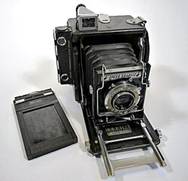
The Graflex Speed Camera mentioned in the novel looks like this:
And as a coda to the July book club read; here is a link to a short documentary about the Farm Security Administration during the Great Depression, which was indeed headed by Roy Stryker, who made appearances in the novel as the fictional photographer, Cleo Allfrey’s boss. The short documentary is produced by the official FDR Presidential Library:
Books Read in the Past Month by Book Club Members
Titles are books unless otherwise noted —
California Sorcery: A Group Celebration edited by William F. Nolan
Here’s a book of magic, all right — all right, dark magic — and its contributors are, as the title implies, sorcerers of their craft. California Sorcery provides a virtual roll call of some of the most important names in the history of 20th-century horror, sci fi, and dark fantasy: Robert Bloch, Ray Bradbury, Richard Matheson, Charles Beaumont — just to name a few. And this is no reprint sham like we’ve seen too many times before; nine of the 12 stories were never-before-published! (The Bloch piece hasn’t seen print in 50 years, and Harlan Ellison’s piece is newly revised.)
We’re talking the greats of the field, folks, guys who were writing high-octane tales of terror when Stephen King was still playing with toy soldiers. (King, in fact, has acknowledged a number of these authors as major influences.) In their day (though many are still actively writing) the contributors here were known in Hollywood as “The California School” or simply, “The Group”; they became a notorious creative coterie due to their sheer, indefatigable talent and, combined, helped brand the entertainment industry with some of the finest scripts, novels, and stories ever produced. Coeditor William Nolan says it best in his foreword: “The Group lives again in this book, brought together at last and for always…”
–
The Foursome: A Novel: by Christina Baker Kline
When Eng and Chang Bunker arrive in Wilkes County in 1839, they’re not just a curiosity—they’re a sensation. Everyone is eager to learn whether the salacious rumors about them are true. Within months, the twins have opened a general store, bought land, and begun building a plantation. Now, word has it, they’re looking for wives—and in a place that thrives on gossip and legacy, their ambitions set the community on edge.
Sarah and Adelaide Yates, daughters of a once-prominent local family brought low by scandal, are drawn into their orbit. Bold, beautiful Adelaide sees in the twins’ fame a chance to reclaim her future. Sarah, quiet and observant, isn’t so sure. When the twins’ lives become entangled with theirs, they must navigate loyalty, longing, and identity in a world where everything—including race, class, and gender—is rigidly defined.
Spanning five decades and unfolding against the backdrop of a fractured nation hurtling toward war, The Foursome is both intimate and epic: a story of love and constraint, identity and reinvention. With piercing insight and emotional precision, Kline brings to life a forgotten chapter of American history and the complex, boundary-defying marriages at its center.
–
Inside the O’Briens: A Novel by Lisa Genova
Joe O’Brien is a forty-three-year-old police officer from the Irish Catholic neighborhood of Charlestown, Massachusetts. A devoted husband, proud father of four children in their twenties, and respected officer, Joe begins experiencing bouts of disorganized thinking, uncharacteristic temper outbursts, and strange, involuntary movements. He initially attributes these episodes to the stress of his job, but as these symptoms worsen, he agrees to see a neurologist and is handed a diagnosis that will change his and his family’s lives forever: Huntington’s disease.
Huntington’s is a lethal neurodegenerative disease with no treatment and no cure, and each of Joe’s four children has a fifty percent chance of inheriting their father’s disease. While watching her potential future in her father’s escalating symptoms, twenty-one-year-old daughter Katie struggles with the questions this test imposes on her young adult life. As Joe’s symptoms worsen and he’s eventually stripped of his badge and more, Joe struggles to maintain hope and a sense of purpose, while Katie and her siblings must find the courage to either live a life “at risk” or learn their fate.
Praised for writing that “explores the resilience of the human spirit” (San Francisco Chronicle), Lisa Genova has once again delivered a novel as powerful and unforgettable as the human insights at its core.
–
John Adams by David McCullough
The Pulitzer Prize–winning, bestselling biography of America’s founding father and second president that was the basis for the acclaimed HBO series, brilliantly told by master historian David McCullough.
In this powerful, epic biography, David McCullough unfolds the adventurous life journey of John Adams, the brilliant, fiercely independent, often irascible, always honest Yankee patriot who spared nothing in his zeal for the American Revolution; who rose to become the second president of the United States and saved the country from blundering into an unnecessary war; who was learned beyond all but a few and regarded by some as “out of his senses”; and whose marriage to the wise and valiant Abigail Adams is one of the moving love stories in American history.
This is history on a grand scale—a book about politics and war and social issues, but also about human nature, love, religious faith, virtue, ambition, friendship, and betrayal, and the far-reaching consequences of noble ideas. Above all, John Adams is an enthralling, often surprising story of one of the most important and fascinating Americans who ever lived.
–
The Most Fun We Ever Had: A Novel by Claire Lombardo
In this “rich, complex family saga” (USA Today) full of long-buried family secrets, Marilyn Connolly and David Sorenson fall in love in the 1970s, blithely ignorant of all that awaits them. By 2016, they have four radically different daughters, each in a state of unrest.
Wendy, widowed young, soothes herself with booze and younger men; Violet, a litigator turned stay-at-home-mom, battles anxiety and self-doubt; Liza, a neurotic and newly tenured professor, finds herself pregnant with a baby she’s not sure she wants by a man she’s not sure she loves; and Grace, the dawdling youngest daughter, begins living a lie that no one in her family even suspects.
With the unexpected arrival of young Jonah Bendt—a child placed for adoption by one of the daughters fifteen years before—the Sorensons will be forced to reckon with the rich and varied tapestry of their past. As they grapple with years marred by adolescent angst, infidelity, and resentment, they also find the transcendent moments of joy that make everything else worthwhile.
–
On Witness and Respair: Essays by Jesmyn Ward
The collected creative nonfiction of a singular American writer, Jesmyn Ward, including widely shared classics, three never-before-published speeches, and an introductory essay.
Respair (noun, obsolete), fresh hope after despair.
From the two-time National Book Award winner and New York Times bestselling author Jesmyn Ward, this collection of essays documents more than a decade of work in the life of a singular writer often lauded as “the heir apparent to Toni Morrison” (LitHub). Beginning with her upbringing in a multigenerational household in rural Mississippi, the cradle of both her youth and her gift for storytelling, Ward brings her keen wisdom and hauntingly lyrical prose to a range of topics, following in her grandmother Dorothy’s footsteps when she promises always to “Tell it straight. Tell it all.”
True to her word, in these pages Ward contemplates the writers and novels of her youth and adulthood—the transformative power of discovering Octavia Butler as a twenty-something, the mirror that Richard Wright’s novels held up to her own childhood, and of course, her lifelong love for Toni Morrison. Ward ruminates on her approach to both fiction and life, reflecting on the power of the novel, how to raise a Black son in an era of rising divisiveness and cruelty, as well as her own personal tragedies—including the titular essay of the collection, which tells the story of her partner’s sudden death on the eve of the COVID-19 epidemic. Every bit as piercing and moving as her fiction, On Witness and Respair is a testament to Ward’s powers as “one of America’s finest living writers” (San Francisco Chronicle) and is a monument to hope, beauty, and personal and collective resilience.
–
Platonic: How the Science of Attachment Can Help You Make–and Keep—Friends by Marisa G. Franco PhD
How do we make and keep friends in an era of distraction, burnout, and chaos, especially in a society that often prizes romantic love at the expense of other relationships? In Platonic, Dr. Marisa G. Franco unpacks the latest, often counterintuitive findings about the bonds between us—for example, why your friends aren’t texting you back (it’s not because they hate you!), and the myth of “friendships happening organically” (making friends, like cultivating any relationship, requires effort!). As Dr. Franco explains, to make and keep friends you must understand your attachment style—secure, anxious, or avoidant: it is the key to unlocking what’s working (and what’s failing) in your friendships.
Making new friends, and deepening longstanding relationships, is possible at any age—in fact, it’s essential. The good news: there are specific, research-based ways to improve the number and quality of your connections using the insights of attachment theory and the latest scientific research on friendship. Platonic provides a clear and actionable blueprint for forging strong, lasting connections with others—and for becoming our happiest, most fulfilled selves in the process.
–
The Tale Teller by Anne Hillerman
Joe Leaphorn may have retired from the Tribal Police, but he finds himself knee-deep in a perplexing case involving a priceless artifact—a reminder of a dark time in Navajo history. Joe’s been hired to find a missing biil, a traditional dress that had been donated to the Navajo Nation. His investigation takes a sinister turn when the leading suspect dies under mysterious circumstances and Leaphorn himself receives anonymous warnings to beware—witchcraft is afoot.
While the veteran detective is busy working to untangle his strange case, his former colleague Jim Chee and Officer Bernie Manuelito are collecting evidence they hope will lead to a cunning criminal behind a rash of burglaries. Their case takes a complicated turn when Bernie finds a body near a popular running trail. The situation grows more complicated when the death is ruled a homicide, and the Tribal cops are thrust into a turf battle because the murder involves the FBI.
As Leaphorn, Chee, and Bernie draw closer to solving these crimes, their parallel investigations begin to merge . . . and offer an unexpected opportunity that opens a new chapter in Bernie’s life.
–
Theo of Golden: A Novel by Allen Levi
One spring morning, a stranger named Theo arrives in the small Southern city of Golden. He doesn’t explain much about where he came from or why he’s there—but when he visits the local coffeehouse, where pencil portraits of the people of Golden hang on the walls, he begins purchasing them, one at a time, and giving each portrait to the person depicted. In exchange, he asks only for the person’s story. And so portrait by portrait, person by person, secrets are revealed, regrets are shared, and ordinary lives are profoundly altered.
A story of giving and receiving, of seeing and being seen, Theo of Golden is an unforgettable novel about the power of generosity, the importance of connection, and the quiet miracles that happen when we choose kindness and wonder.
–
The Wager: A Tale of Shipwreck, Mutiny and Murder by David Grann
On January 28, 1742, a ramshackle vessel of patched-together wood and cloth washed up on the coast of Brazil. Inside were thirty emaciated men, barely alive, and they had an extraordinary tale to tell. They were survivors of His Majesty’s Ship the Wager, a British vessel that had left England in 1740 on a secret mission during an imperial war with Spain. While the Wager had been chasing a Spanish treasure-filled galleon known as “the prize of all the oceans,” it had wrecked on a desolate island off the coast of Patagonia. The men, after being marooned for months and facing starvation, built the flimsy craft and sailed for more than a hundred days, traversing nearly 3,000 miles of storm-wracked seas. They were greeted as heroes.
But then … six months later, another, even more decrepit craft landed on the coast of Chile. This boat contained just three castaways, and they told a very different story. The thirty sailors who landed in Brazil were not heroes – they were mutineers. The first group responded with countercharges of their own, of a tyrannical and murderous senior officer and his henchmen. It became clear that while stranded on the island the crew had fallen into anarchy, with warring factions fighting for dominion over the barren wilderness. As accusations of treachery and murder flew, the Admiralty convened a court martial to determine who was telling the truth. The stakes were life-and-death—for whomever the court found guilty could hang.
The Wager is a grand tale of human behavior at the extremes told by one of our greatest nonfiction writers. Grann’s recreation of the hidden world on a British warship rivals the work of Patrick O’Brian, his portrayal of the castaways’ desperate straits stands up to the classics of survival writing such as The Endurance, and his account of the court martial has the savvy of a Scott Turow thriller. As always with Grann’s work, the incredible twists of the narrative hold the reader spellbound.
–
Young George Washington (2026) (Movie)
Before he became the first President of the United States, young George Washington tests his honor, loyalty and courage by fighting in the French and Indian War. As alliances crumble and the frontier erupts into battle, he must confront not only his enemies, but the man he’s becoming.
–
Whistler: A Novel by Ann Patchett
When Daphne Fuller and her husband Jonathan visit the Metropolitan Museum of Art, they notice an older, white-haired gentleman following them. The man turns out to be Eddie Triplett, her former stepfather, who had been married to her mother for a little more than year when Daphne was nine. Now fifty-three, Daphne hasn’t seen Eddie for many years, not since the fateful event that changed the direction of both their lives. Meeting again, time falls away; while their relationship was brief, it had a profound impact on them both, and now that they are reunited, they have no intention of ever being separated again.
Whistler is a story about two adults looking back over the choices they made, and the choices that were made for them. It’s a story about bravery, memory, the often small yet consequential moments that define our lives, and the endless stream of loss that in time comes for us all. Beautiful in its simplicity, it is ultimately about how love endures, and how the feeling of being known by one other person, even for a short period of time, can change everything.
To see a list of upcoming library events, visit the library’s calendar of events page via the following link: https://ssclibrary.org/calendar/
Alternatively, you can search for eBooks and eAudios via the Libby or Hoopla apps – all you need is a library card; if you have questions please call the library at: 607-936-3713
We’ll be discussing the novel The Antidote by Karen Russell; copies of which are available at the Circulation Desk if anyone needs a copy.
Here is the Starred Booklist review of the title:
The Antidote by Karen Russell: The prairie witch calls herself The Antidote because people feel so much better after she unburdens them of painful memories, storing them in her “vault.” But when she finds herself in jail in the midst of a terrifying dust storm in Uz, Nebraska, she realizes that the deposits she’s been paid to protect have vanished. High-school basketball star Asphodel Oletsky, living, since her mother was murdered, with her uncle Harp, a dryland farmer, is desperate to keep her winning team on the court after they lose their sponsor. Harp is haunted by how his Polish parents were forced off their land by the Germans, only to find themselves unwittingly doing the same to Native Americans. New Deal photographer Cleo Allfrey, at risk on the plains as a Black woman, arrives in Uz during the worst of the Dust Bowl and finds people pushed to the brink by drought, deadly and otherworldly dust storms, vanished crops and topsoil, unsolved murders, and a corrupt and brutal sheriff. Among many strange occurrences, Cleo’s photographs inexplicably depict the horrific past and a possible future. Highly honored Russell follows two stellar story collections with her second novel, an ardent work of encompassing and compassionate historical fiction supercharged with her signature imaginative, astutely calibrated supernatural twists. A dramatic and uncanny tale of the drastic consequences of our destruction of nature and Indigenous communities.
Looking forward to August, we’ll be meeting on Friday, August 14 from 3:00 – 4:00 p.m. and we’ll be discussing the novel The Correspondent by Virginia Evans.
Here is the Publishers Weekly Review of the novel:
The Correspondent by Virginia Evans: The charming debut from Evans takes the form of letters and emails exchanged by a divorced and retired woman with her friends, family, foes, and literary idols. It begins in 2012 as Sybil Van Antwerp, 73, politely declines an invitation to visit her brother, Felix, in France, then fancifully invites the author Ann Patchett to use her Maryland home as a writer’s retreat. Sybil spent her career clerking for a judge, and after reading of his death in the newspaper, she begins receiving strange and threatening letters from an aggrieved former defendant, who calls her a “cold metal bitch.” Evans juxtaposes these screeds with Sybil’s intimate fan mail to Joan Didion, who writes her back in 2013, expressing empathy as a fellow member of “the club of parents who have buried children” (Sybil lost a son at eight). Sybil, who was adopted, grows curious about her ancestry after her older son gives her a DNA test for Christmas, and she brushes off concerns about her declining eyesight from her daughter, Fiona, who lives in Australia. As the years go on, Sybil’s relationships brim with tension waiting to be released, and the detailed connections between each character are brilliantly mapped through the correspondence. It adds up to an appealing family drama.
–
And just as FYI, the Summer Reading seasons has started & you can sign up for the Summer Reading program at the Reference Desk. You can win prizes for reading and improve library stats too!
There are also special events for all ages during the Summer Reading Program season and here is the Summer Reading Programming brochure with all the events, dates & times:
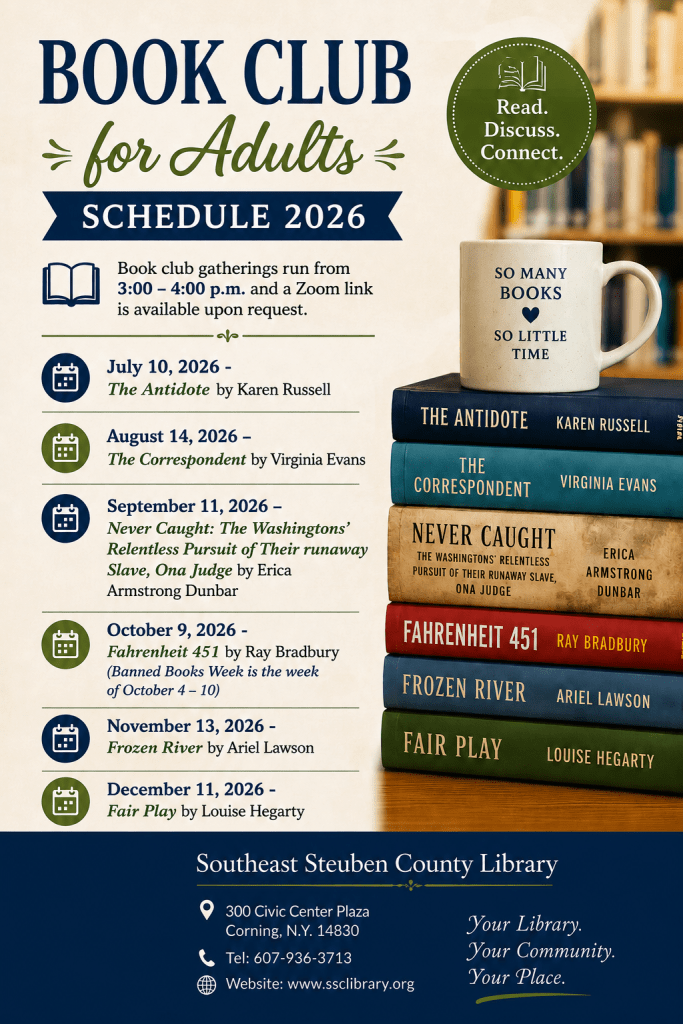
And here is the updated Book Club Schedule for the balance of 2026:
–
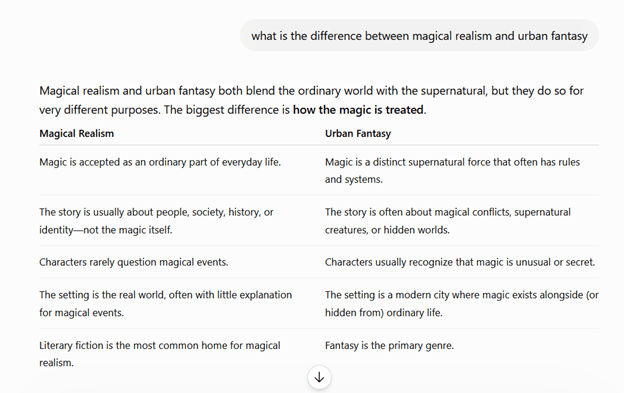
What’s the difference between: “Magical Realism” and “Urban Fantasy?” This topic came up during our June gathering, and I thought I’d check so I’d have a more concrete answer to the question!
So here is more information on the subject:
Magical Realism
In magical realism, the extraordinary is woven seamlessly into everyday life. The magical elements are rarely explained because the story is not about the magic—it is about the human experience.
Examples
One Hundred Years of Solitude — Gabriel García Márquez
Love in the Time of Cholera — Gabriel García Márquez (contains magical realist elements)
The House of the Spirits — Isabel Allende
Like Water for Chocolate — Laura Esquivel
Beloved — Toni Morrison
The Famished Road — Ben Okri
Exit West — Mohsin Hamid
The Particular Sadness of Lemon Cake — Aimee Bender
Urban Fantasy
Urban fantasy takes place in a recognizable modern world where magic, supernatural beings, or mythical creatures exist alongside ordinary life—often hidden from most people.
Examples
Storm Front — Jim Butcher
Moon Called — Patricia Briggs
Magic Bites — Ilona Andrews
Rivers of London — Ben Aaronovitch
Neverwhere — Neil Gaiman
American Gods — Neil Gaiman
Dead Until Dark — Charlaine Harris
Rosemary and Rue — Seanan McGuire
–
Books Read by Book Club Members in June (and reported at the June gathering):
God Impulse: The Power of Mercy In An Unmerciful World by Jack Alexander: For Jesus, truth and mercy went hand in hand. Where he preached he also healed. He didn’t outsource one or the other to biblical scholars or nonprofit ministries. He presented the truth of the gospel through his words and his actions, and he did it all in a hands-on, relational way. And the reaction was the same wherever he went–people were amazed.
Today we seem to have lost this powerful pattern of self-giving love, focusing on truth at the expense of mercy or on mercy at the expense of truth, and often failing to build genuine, lasting relationships with the people around us.
In The God Impulse, Jack Alexander helps us recover Jesus’s model, showing through biblical and modern real-life stories that God’s first impulse toward us is mercy. He then sets forth a pattern for us to follow–to see, go, do, and endure–that not only spreads truth and love to those around us who are suffering but also causes them to gasp in amazement and consider the claims of the gospel for themselves.
–
God: A Biography: Pulitzer Prize Winner by Jack Miles: WINNER OF THE PULITZER PRIZE
What sort of “person” is God? What is his “life story”? Is it possible to approach him not as an object of religious reverence, but as the protagonist of the world’s greatest book—as a character who possesses all the depths, contradictions, and ambiguities of a Hamlet? This is the task that Jack Miles—a former Jesuit trained in religious studies and Near Eastern languages—accomplishes with such brilliance and originality in God: A Biography.
Using the Hebrew Bible as his text, Miles shows us a God who evolves through his relationship with man, the image who in time becomes his rival. Here is the Creator who nearly destroys his chief creation; the bloodthirsty warrior and the protector of the downtrodden; the lawless law-giver; the scourge and the penitent. Profoundly learned, stylishly written, the resulting work illuminates God and man alike and returns us to the Bible with a sense of discovery and wonder.
–
Isola by Allegra Goodman: Heir to a fortune, Marguerite is destined for a life of prosperity and gentility. Then she is orphaned, and her guardian—an enigmatic and volatile man—spends her inheritance and insists she accompany him on an expedition to New France. That journey takes a unexpected turn when Marguerite, accused of betrayal, is brutally punished and abandoned on a small island.
Once a child of privilege who dressed in gowns and laced pearls in her hair, Marguerite finds herself at the mercy of nature. As the weather turns, blanketing the island in ice, she discovers a faith she’d never before needed.
Inspired by the real life of a sixteenth-century heroine, Isola is the timeless story of a woman fighting for survival.
–
On Witness and Respair: Essays by Jesmyn Ward: From the two-time National Book Award winner and New York Times bestselling author Jesmyn Ward, this collection of essays documents more than a decade of work in the life of a singular writer often lauded as “the heir apparent to Toni Morrison” (LitHub).
Beginning with her upbringing in a multigenerational household in rural Mississippi, the cradle of both her youth and her gift for storytelling, Ward brings her keen wisdom and hauntingly lyrical prose to a range of topics, following in her grandmother Dorothy’s footsteps when she promises always to “Tell it straight. Tell it all.”
True to her word, in these pages Ward contemplates the writers and novels of her youth and adulthood—the transformative power of discovering Octavia Butler as a twenty-something, the mirror that Richard Wright’s novels held up to her own childhood, and of course, her lifelong love for Toni Morrison. Ward ruminates on her approach to both fiction and life, reflecting on the power of the novel, how to raise a Black son in an era of rising divisiveness and cruelty, as well as her own personal tragedies—including the titular essay of the collection, which tells the story of her partner’s sudden death on the eve of the COVID-19 epidemic. Every bit as piercing and moving as her fiction, On Witness and Respair is a testament to Ward’s powers as “one of America’s finest living writers” (San Francisco Chronicle) and is a monument to hope, beauty, and personal and collective resilience.
–
The Retirement Plan: A Novel by Sue Hincenbergs:
THEY’D KILL TO BE WIDOWS.
Three best friends turn to murder to collect on their husbands’ life insurance policies… But the husbands have a plan of their own in this darkly funny debut suspense novel that will delight readers from the first laugh to the final twist.
After thirty years of friendship, Pam dreams of her perfect retirement with Nancy, Shalisa, Marlene, and their husbands—until their husbands pool their funds for an investment that goes terribly wrong. Suddenly, in this witty domestic thriller, their golden years are looking as dreary as their marriages.
But when the women discover their husbands have seven-figure life insurance policies, a new dream forms. And this time, they need a hitman.
Meanwhile, their husbands are working on their own secret retirement scheme and when things begin to go sideways, they fear it’s backfired. The husbands scramble to stay alive…but soon realize they may not be quick enough to outmaneuver their wives.
–
Theo of Golden by Allen Levi: One spring morning, a stranger named Theo arrives in the small Southern city of Golden. He doesn’t explain much about where he came from or why he’s there—but when he visits the local coffeehouse, where pencil portraits of the people of Golden hang on the walls, he begins purchasing them, one at a time, and giving each portrait to the person depicted. In exchange, he asks only for the person’s story. And so portrait by portrait, person by person, secrets are revealed, regrets are shared, and ordinary lives are profoundly altered.
A story of giving and receiving, of seeing and being seen, Theo of Golden is an unforgettable novel about the power of generosity, the importance of connection, and the quiet miracles that happen when we choose kindness and wonder.
–
Two Women Living Together by Kim Hana & Hwang Sunwoo: The big-hearted, bestselling South Korean memoir co-written by two best friends flouting gender norms and societal expectations with their decision to grow old together under one roof.
When most of their peers were moving in with romantic partners and having children, Kim Hana and Hwang Sunwoo chose independence—savoring solitude, quiet mornings, and the unmitigated freedom of living alone. But in their forties, something shifted, and they were met with a new, unexpected loneliness. Refusing to settle for the outdated choice between marriage or isolation, Hana and Sunwoo made a radical decision: to buy a home and live together—not as lovers, not as roommates, but as chosen family.
Now a bustling household of two women and four cats, Hana and Sunwoo still value solitude, but can do so while sharing a life and its meaning with someone else. Together they navigate the challenges and comforts of cohabiting in midlife, the growing pains of interdependence and the unexpected rewards of compromise when you’ve grown set in your ways. From sick days to career wins to aging parents and beach-side retirement plans, they are redefining domestic bliss on their own terms, where love, partnership, and home are defined not by tradition, but by choice.
With warmth, wit, and sharp social insight, Hana and Sunwoo share their blueprint for building a life outside the scripts of marriage and society’s expectations for women. Two Women Living Together is a quiet revolution—a celebration of female friendship, community, and the many forms that love and family can take.
–
The Universal Christ: How a Forgotten Reality Can Change Everything We See, Hope For, and Believe by Richard Rohr and Brian D. Mclaren: “Anyone who strives to put their faith into action will find encouragement and inspiration in the pages of this book.”—Melinda Gates
In his decades as a globally recognized teacher, Richard Rohr has helped millions realize what is at stake in matters of faith and spirituality. Yet Rohr has never written on the most perennially talked about topic in Christianity: Jesus. Most know who Jesus was, but who was Christ? Is the word simply Jesus’s last name? Too often, Rohr writes, our understandings have been limited by culture, religious debate, and the human tendency to put ourselves at the center.
Drawing on scripture, history, and spiritual practice, Rohr articulates a transformative view of Jesus Christ as a portrait of God’s constant, unfolding work in the world. “God loves things by becoming them,” he writes, and Jesus’s life was meant to declare that humanity has never been separate from God—except by its own negative choice. When we recover this fundamental truth, faith becomes less about proving Jesus was God, and more about learning to recognize the Creator’s presence all around us, and in everyone we meet.
Thought-provoking, practical, and full of deep hope and vision, The Universal Christ is a landmark book from one of our most beloved spiritual writers, and an invitation to contemplate how God liberates and loves all that is.
–
Wild Thing: A Life of Paul Gauguin by Sue Prideaux: An original and revealing portrait of the misunderstood French Post-Impressionist artist.
Paul Gauguin’s legend as a transgressive genius arises as much from his biography as his aesthetically daring Polynesian paintings. Gauguin is chiefly known for his pictures that eschewed convention, to celebrate the beauty of an indigenous people and their culture. In this gorgeously illustrated, myth-busting work, Sue Prideaux reveals that while Gauguin was a complicated man, his scandalous reputation is largely undeserved.
Self-taught, Gauguin became a towering artist in his brief life, not just in painting but in ceramics and graphics. He fled the bustle of Paris for the beauty of Tahiti, where he lived simply and worked consistently to expose the tragic results of French Colonialism. Gauguin fought for the rights of Indigenous people, exposing French injustices and corruption in the local newspaper and acting as advocate for the Tahitian people in the French colonial courts. His unconventional career and bold, breathtaking art influenced not only Vincent van Gogh, but Matisse and Picasso.
Wild Thing upends much of what we thought we knew about Gauguin through new primary research, including the resurfaced manuscript of Gauguin’s most important writing, the untranslated memoir of Gauguin’s son, and a sample of Gauguin’s teeth that disproves the pernicious myth of his syphilis. In the first full biography of Paul Gauguin in thirty years, Sue Prideaux illuminates the extraordinary oeuvre of a visionary artist vital to the French avant-garde. The result is “a brilliantly readable and compassionate study of Gauguin―not just as a painter, sculptor, carver and potter, but as a human soul perpetually searching for what is always just out of reach” (Artemis Cooper, Spectator).
–
Yesteryear by Caro Claire Burke: Natalie lives a traditional lifestyle. Her charming farmhouse is rustic, her husband a handsome cowboy, her six children each more delightful than the last. So what if there are nannies and producers behind the scenes, her kitchen hiding industrial-grade fridges and ovens, her husband the heir to a political dynasty? What Natalie’s followers—all 8 million of them—don’t know won’t hurt them. And The Angry Women? The privileged, Ivy League, coastal elite haters who call her an antifeminist iconoclast? They’re sick with jealousy. Because Natalie isn’t simply living the good life, she’s living the ideal—and just so happens to be building an empire from it.
Until one morning she wakes up in a life that isn’t hers. Her home, her husband, her children—they’re all familiar, but something’s off. Her kitchen is warmed by a sputtering fire rather than electricity, her children are dirty and strange, and her soft-handed husband is suddenly a competent farmer. Just yesterday Natalie was curating photos of homemade jam for her Instagram, and now she’s expected to haul firewood and handwash clothes until her fingers bleed. Has she become the unwitting star of a ruthless reality show? Could it really be time travel? Is she being tested by God? By Satan? When Natalie suffers a brutal injury in the woods, she realizes two things: This is not her beautiful life, and she must escape by any means possible.
A gripping, electrifying novel that is as darkly funny as it is frightening, Yesteryear is a gimlet-eyed look at tradition, fame, faith, and the grand performance of womanhood.
Hi everyone, just a quick reminder; the June Book Club for Adults gathering is this Friday, June 12, 2026, start time 3:00 p.m.
We’ll be discussing the book “My Name Is Emilia del Valle” by Isabel Allende. The novel is set in the mid-nineteenth century and tells the story of the character of the title, Emilia del Valle. Emilia is born in San Francisco in 1866 the out-of-wedlock daughter of an Irish nun and a Chilean aristocrat. She is raised by her supportive stepfather and grows into a strong willed, independent woman with a passion for writing. As an adult, she finds love and encounters her father while perusing her calling to write. The novel unfolds during the Chilean Civil War. Copies of the back are still available at the Circulation Desk.
Zoom link available upon request; you can request the link by sending an email to: reimerl@stls.org
Looking forward, our July read is “The Antidote” by Karen Russell. The Antidote is a critically acclaimed novel, which has a bit of everything. It unfolds in the small town of Uz, Nebraska during the Great Depression, during a dust storm, and follows an ensemble cast of characters including prairie witch Antonina Rossi who is something of a counselor for local residents, Harp Oletsky a man who stood with his parents as Pawnee people were driven from their land – the land his family was settling, Dell Oletsky a 15-year-old basketball prodigy whose mother Lada was just murdered, hobo Clemson Louis Dew who has falsely been convicted of Lada’s murder and Cleo Allfrey, a black New Deal photographer, who doesn’t believe Clemson Dew is guilty.
And looking backwards to our May; in May we read and discussed “Travels With George” by Nathaniel Philbrick. The book was inspired by John Steinbeck’s famous 1962 travelogue “Travels With Charley” which chronicled Steinbeck’s cross-country trip from Maine to California with his wife’s dog Charley. Steinbeck, who was in shaky health, wanted to see America, and what Americans were like; one last time before he passed. Taking a page out of Steinbeck’s book, Nathaiel Philbrick’s goal was to travel the roads George Washington traveled in 1780, to meet and greet Americans and see what their thought and concerns were about the state of the word; after he was elected President and before he settled down to govern. Two hundred and twenty-nine years after Washington made that trip, Philbrick, accompanied by his wife Melissa and their dog Dora, followed in his footsteps, traveling the same roads and reflecting on the history of the United States, with a strong emphasis on George Washington and the formative years of the country, and pondering the ways that, that history is important today and reflects who we are as a nation.
Hi everyone, the May book club for adults gathering is this Friday, May 8, 2026.
We’ll be meeting at the library at 3:00 p.m. and discussing the book Travels With George by Nathaniel Philbrick; copies of the book are available at the Circulation Desk if anyone needs a copy. If you’d like to attend the gathering from home, let me know and I’ll send you the Zoom link.
And looking forward to June, as usual we’ll be meeting the second Friday of the month – in June that is Friday, June 12, from 3:00 – 4:00 p.m.
And our June Reads is My Name Is Emilia del Valle: A Novel by Isabel Allende and Frances Riddle; and here the Booklist review of the novel:
Allende has created many addictive sagas about the extended del Valle family and their intersections with history and one another. The eponymous Emilia, Allende’s addition to this notable clan, is one adventurous, gutsy woman. The illegitimate daughter of a Chilean aristocrat and the Irish novice nun he seduced, Emilia grows up in San Francisco with her loving stepfather’s support, intrepidly working around gender restrictions. After penning dime novels pseudonymously, she becomes a human-interest columnist for the Daily Examiner and wangles an assignment as international correspondent for the impending Chilean Civil War of 1891, under her own byline. Emilia’s first meeting with her long-lost father in Santiago is quite moving, and her time with the canteen girls who accompany President Balmaceda’s army echoes with their unsung courage. Allende expertly navigates through the violent chaos of battle and how it affects Emilia, whose romantic relationships also showcase her character growth. Fans of Allende’s now-classic Daughter of Fortune (1999) and Portrait in Sepia (2000) will particularly welcome this offering, which is replete with Allende’s customary poetic storytelling.
HIGH-DEMAND BACKSTORY: Allende fans are legion and her continuation the del Valle family saga will inspire many requests.
Copies of our June read may also be picked up at the Circulation Desk at any time.
Hi everyone, our April 2026 book club gathering is tomorrow, Friday, April 10, 2026.
We’ll be meeting at the library from 3:00 – 4:00 p.m. to discuss the novel the Seven Husbands of Evelyn Hugo by Taylor Jenkins Reid.
A Zoom link is available upon request, if you’d like to join the discussion from home, just send me an email at reimerl@stls.org
Looking forward to May; our May gathering will be held at the library on Friday, May 8, 2026 from 3:00 – 4:00 p.m.
Our May Read is:
Travels with George: In Search of Washington and His Legacy by Nathaniel Philbrick
Copies of Travels With George may be picked up at the Circulation Desk anytime during library hours of operation.
Here’s an overview of the book:
When George Washington became president in 1789, the United States of America was still a loose and quarrelsome confederation and a tentative political experiment. Washington undertook a tour of the ex-colonies to talk to ordinary citizens about his new government, and to imbue in them the idea of being one thing—Americans.
In the fall of 2018, Nathaniel Philbrick embarked on his own journey into what Washington called “the infant woody country” to see for himself what America had become in the 229 years since. Writing in a thoughtful first person about his own adventures with his wife, Melissa, and their dog, Dora, Philbrick follows Washington’s presidential excursions: from Mount Vernon to the new capital in New York; a monthlong tour of Connecticut, Massachusetts, New Hampshire, and Rhode Island; a venture onto Long Island and eventually across Georgia, South Carolina, and North Carolina. The narrative moves smoothly between the eighteenth and twenty-first centuries as we see the country through both Washington’s and Philbrick’s eyes.
Written at a moment when America’s founding figures are under increasing scrutiny, Travels with George grapples bluntly and honestly with Washington’s legacy as a man of the people, a reluctant president, and a plantation owner who held people in slavery. At historic houses and landmarks, Philbrick reports on the reinterpretations at work as he meets reenactors, tour guides, and other keepers of history’s flame. He paints a picture of eighteenth-century America as divided and fraught as it is today, and he comes to understand how Washington compelled, enticed, stood up to, and listened to the many different people he met along the way—and how his all-consuming belief in the union helped to forge a nation.
Hi everyone, the next Book Club for Adults gathering will be at the library this Friday, March 13, 2026. And will run from 3:00 – 4:00 p.m.
I have now added Zoom access and you can get the Zoom link by simply letting me know you’d like to join us via Zoom – just send me an email request at: reimerl@stls.org
This month we will be discussing the novel Bug Hollow by Michelle Huneven.
We will be meeting in the library’s Conference Room, located in the back of the library, past the Reference Desk from 3:00 – 4:00 p.m.
And during our March gathering we will discuss our April read, which is is currently Mrs. Lilienblum’s Cloud Factory; but due to the book not being available in paperback, and only one copy being available within the system to request – I think we should change our April read to a different title – and we can figure out which one at our March gathering. So bring a list of your recent favorite reads with you!
And if you like whimsical reads, check out Mrs. Lilienblum’s Cloud Factory – it is a colorful read – here is a review of the title from the Jewish Book Council site:
Hi everyone, our monthly book club gathering for adults is today at 3:00 p.m. at the Southeast Steuben County Library.
Our January Read is The Serviceberry by Robin Wall Kimmerer, which discusses in depth for a short book, the differences between a Capitalistic Economy based on scarcity and one that profits the individual versus a natural gift-giving-reciprocal-community building style of economics that fosters a symbiotic relationship among plants/people; the botanist author compares this reciprocally beneficial economy to life in the natural world, and in particular to the way Serviceberry and how they grow and offer sustenance to other plants and animals by their photosynthesis, and how other plants/animals then take their berries and return the favor, for example the birds who eat their seeds, digest them and then drop them in a variety of locations so more Serviceberry plants can grow.
We’ll be meeting from 3:00 – 4:00 p.m. and everyone is welcome – no registration is required – simply show up.
In February, we’ll be meeting on, as usual, the second Friday of the month, Friday, February 13 at 3:00 p.m. and we will be discussing the book My Friends by Fredrik Backman, copies of which may be picked up at the Circulation Desk starting today.
Hi everyone, here is our monthly book club meeting reminder post!
Our August Book Club for Adults gathering will be held at the library this Friday, August 8, from 3:00 – 4:00 p.m.
We are doing something a bit different this month and reading a graphic novel, A First Time For Everything by Dan Santat.
A First Time For Everything won a National Book Award in 2023 for Young People’s Literature, and it is a bit of a bildungsroman.
And although the book is classified as fiction, it is based on a true story, in essence the experiences of the author Dan Santat who, as most of us do, found it challenging to be young, attending school and dealing with other students who were also finding their way in the world, and not always being kind to others while doing so. The book cumulates with Dan going on a class trip to France and finding his first real girlfriend, and basically, just growing up a bit. The graphics are well done, and it is a reasonably short read, so if you haven’t read it yet – you still have time to do so! Copies of the novel are available at the Circulation Desk.
And looking forward to September, we’ll be meeting on Friday, September 12 and our September read is: The Midnight Library by Matthew Haig, copies of that novel too may be picked up at the Circulation Desk at any time.
Hope everyone is having a good summer, and I hope to see you all on Friday,
Hi everyone, just a reminder, the Southeast Steuben County Library Book Club for Adults will be gathering for our monthly meeting this Friday, July 11 at 3:00 p.m.
We’ll be discussing our July Read, Tell Me Everything by Elizabeth Strout; copies of the book are available at the Circulation Desk should anyone need one.
Looking forward to August, we’ll be meeting on our usual second Friday of the month, on Friday, August 8 at 3 p.m.
And we’ll be doing something different and a bit light in keeping with the summer season and reading the graphic memoir, A First Time for Everything by Dan Santat.
The memoir won the National Book Award for Young People’s Literature in 2023, and tells the story of a student named Dan who had been bullied at school; and has low expectations for how his upcoming school trip to France is going to unfold for him; but during the trip he experiences new things and expands his world-view which is thus enriched with possibilities.
And going forward, I will have a printed list both of the books our book club has read, since its inception in 2019, and the titles book club members mentioned during the previous book club meeting for all who are interested in reading lists to enjoy.